
API Comparison Table

Heading 1

Heading 2

Heading 3

Heading 4

Heading 5
Heading 6

Lorem ipsum dolor sit amet, consectetur adipiscing elit, sed do eiusmod tempor incididunt ut labore et dolore magna aliqua. Ut enim ad minim veniam, quis nostrud exercitation ullamco laboris nisi ut aliquip ex ea commodo consequat. Duis aute irure dolor in reprehenderit in voluptate velit esse cillum dolore eu fugiat nulla pariatur.

Block quote

Ordered list

  1. Item 1
  2. Item 2
  3. Item 3

Unordered list

Text link

Bold text

Emphasis

Superscript

Subscript

Pricing
Get started
Get started

Read more

Speech-To-Text

Speech-to-text for AI medical scribes: Why clinical vocabulary breaks generic STT

TL;DR: Generic STT engines fail in clinical environments because language model probability overrides correct acoustic detection of medical terms, substituting phonetically plausible but clinically wrong candidates silently. The result corrupts drug names, dosages, and diagnoses before the LLM ever sees them. Before selecting an STT engine for a medical scribe, verify four things: whether vocabulary biasing works at inference time without fine-tuning, whether async diarization accurately separates clinician and patient audio, whether the model holds up on noisy consultation recordings rather than clean read-speech, and whether the vendor's data training policy covers PHI by default on your plan.

Speech-To-Text

Migrating from self-hosted Whisper to a managed speech-to-text API

TL;DR: Self-hosting Whisper's true cost rarely sits in the model weights. GPU idle time, VRAM leaks under parallel load, and the engineering hours spent maintaining CUDA dependencies and diarization pipelines are where the bill compounds. For teams processing under roughly 3,000 hours per month, assuming 20% of one US FTE at $150K loaded annual cost, a managed API is cheaper, though the break-even shifts materially against your actual labor cost. Above that threshold, the decision depends on your DevOps overhead and whether audio accuracy on real-world recordings matters for downstream systems like CRM sync and coaching scores.

Speech-To-Text

Migrating from AssemblyAI to Gladia: A step-by-step switching guide

TL;DR: Switching from AssemblyAI requires four concrete changes: update one auth header, remap batch endpoints, adjust the JSON response schema, and resample audio for WebSocket connections. Multiple customers independently report completing these in under a day with a rollback abstraction layer in place. The bigger structural difference is cost model: a production stack with diarization, sentiment, entities, and summarization runs $0.30/hr on AssemblyAI's Universal-2 tier because each feature is metered separately, versus a bundled base rate. This guide covers the exact parameter mappings, payload diffs, WebSocket reconfiguration, and a zero-downtime cutover strategy.

New: Buyer's Guide to Speech-to-Text APIs

Published on May 22, 2025
New: Buyer's Guide to Speech-to-Text APIs

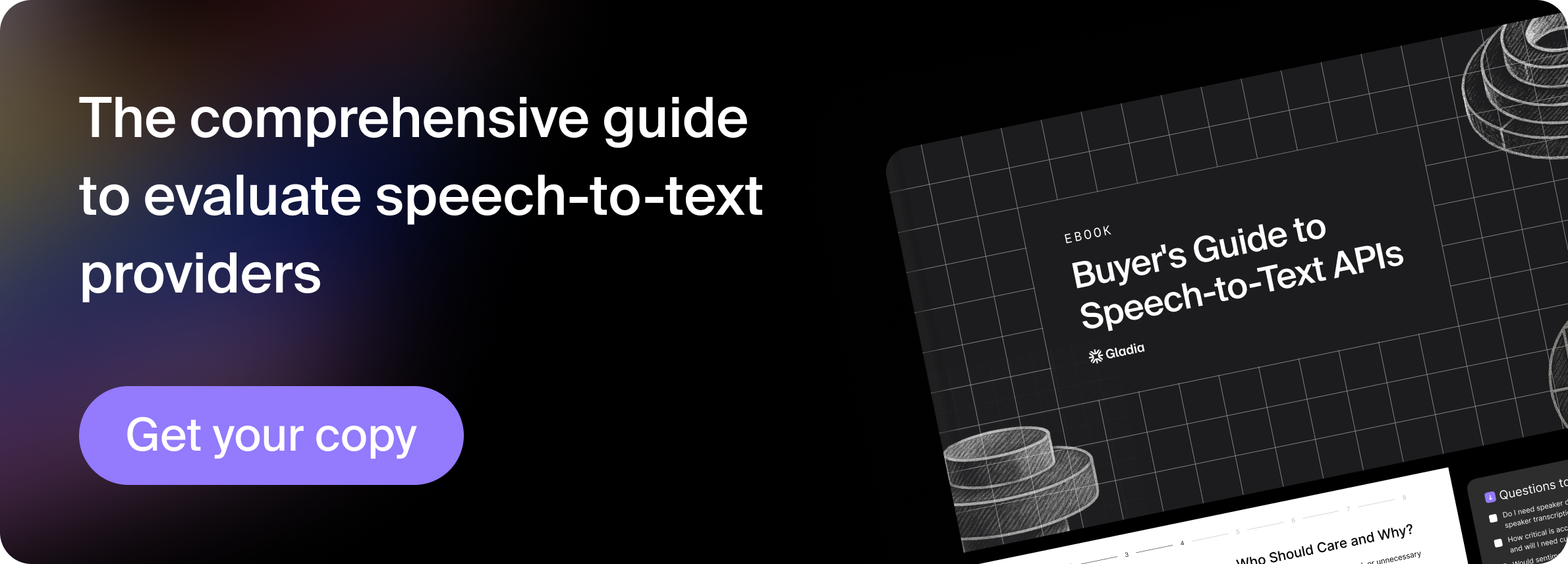
As the landscape of speech-to-text APIs continues to evolve—with growing demands around latency, language support, and compliance—it’s more important than ever to ensure that your setup aligns with your product’s direction.

Introducing the STT API Buyer’s Guide a practical resource for product teams to evaluate, compare, and optimize STT solutions for evolving needs.

Inside, you'll find:
▪️ Key criteria to assess APIs more strategically
▪️ Must-ask questions for your vendor
▪️ Insights to help you minimize trade-offs as you scale

Whether you're building voice agents, call analytics, or video transcription, this guide will help you get more value from your API setup.

__wf_reserved_inherit

Contact us

280
Your request has been registered
A problem occurred while submitting the form.

Read more