Lorem ipsum dolor sit amet, consectetur adipiscing elit, sed do eiusmod tempor incididunt ut labore et dolore magna aliqua. Ut enim ad minim veniam, quis nostrud exercitation ullamco laboris nisi ut aliquip ex ea commodo consequat. Duis aute irure dolor in reprehenderit in voluptate velit esse cillum dolore eu fugiat nulla pariatur.
MiFID II and FCA call recording: compliance for voice transcription in finance
TL;DR: Financial firms operating under MiFID II and FCA jurisdictions must maintain searchable, high-accuracy records of all client-related voice communications, including remote and mobile calls under FCA Market Watch 66. Engineering and product teams building for these obligations typically implement dedicated cloud infrastructure with defined data residency, controls that prevent customer audio from being used to retrain models on Growth and Enterprise plans, and transcription accurate enough that the resulting records hold up under regulatory review. Transcription and speaker attribution errors are not product quality issues in this context. They are audit trail failures, and regulators treat them as such.
Why speech-to-text accuracy matters upstream of your LLM
TL;DR: Downstream LLM performance is ceiling-bounded by upstream transcription accuracy. A transcript with a meaningful error rate doesn't produce proportionally degraded summaries or CRM entries. It produces outputs where hallucinated names, inverted logic, and misattributed speaker turns compound silently into every downstream system that reads them. Prompt engineering cannot recover information the STT layer never captured. Gravite cut call quality review time by 93%, from 15 minutes to 1 minute per call, once transcript accuracy was high enough to trust the output without manual verification.
TL;DR: Telephony audio is constrained to 8kHz narrowband frequencies, stripping away the high-frequency spectral energy that generic 16kHz STT models require. Standard upsampling cannot recover phonemes that were never captured at the source, leading to transcription errors that compound silently into downstream NLU failures. Solaria-3 ranks #1 on Switchboard, the most challenging conversational telephony dataset, ahead of AssemblyAI, ElevenLabs, Deepgram, Mistral, and Speechmatics, ensuring your downstream LLM pipelines receive clean, structured data from real-world noisy call audio.
AssemblyAI pricing: Is it worth it or consider Gladia?
Published on Feb 04, 2026
By Matija Laznik
If you've ever tried to navigate AssemblyAI's pricing page: adding up the base transcription rate, speaker identification, sentiment analysis, plus entity detection—you know that calculating your actual monthly cost requires a spreadsheet and some patience.
AssemblyAI has established itself as a leading speech-to-text and audio intelligence platform, processing billions of API calls for companies ranging from startups to Fortune 500 enterprises. The platform offers a comprehensive suite of features, from core transcription to advanced capabilities like LeMUR for applying large language models to audio data. But as AssemblyAI has expanded its feature set and positioned itself as a broader Voice AI platform, its pricing has evolved into a granular add-on model where each capability carries its own per-hour charge.
This guide analyzes AssemblyAI's pricing structure, add-on costs, and feature tiers. AssemblyAI is the ideal choice if:
You want granular control over exactly which features you pay for
You need LeMUR for applying LLMs to transcribed audio
Your primary need is basic transcription without many add-ons
You have the technical resources to calculate and optimize costs
You value an established platform with extensive documentation.
However, AssemblyAI's pricing may not be the best choice if:
You want predictable costs without calculating multiple add-ons
You need speaker diarization, summarization, and other features included by default
Strong multilingual support with code-switching across many languages is essential
You prefer transparent pricing that scales predictably
Data privacy without pricing implications is important.
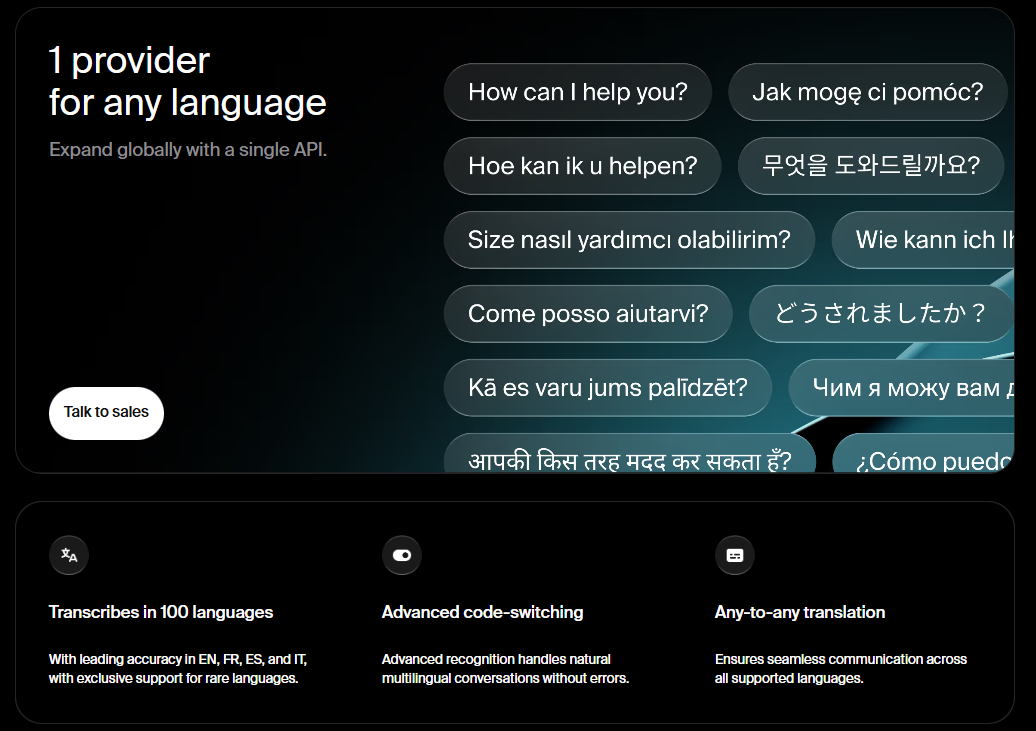
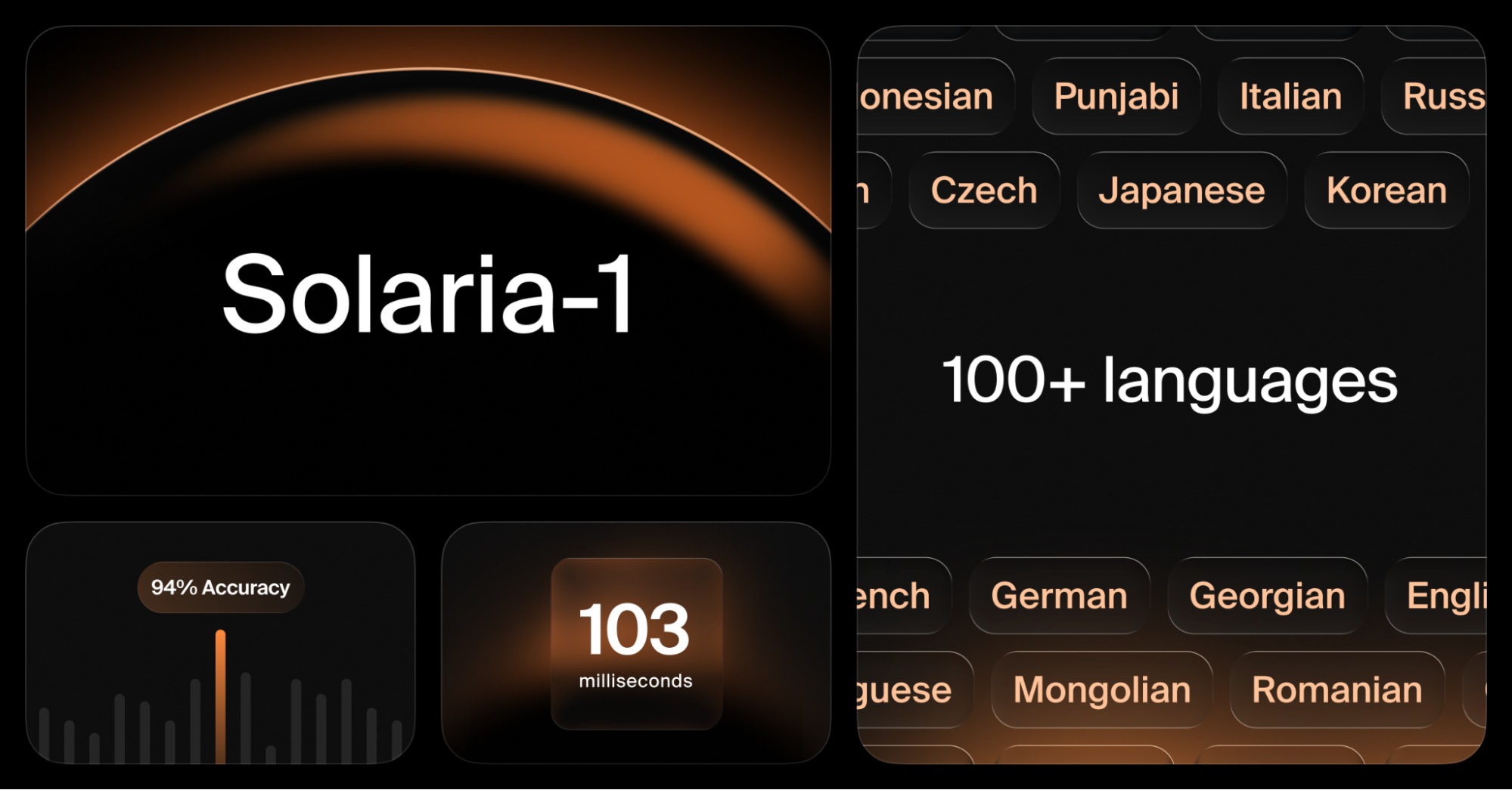
Gladia offers a compelling alternative: a speech AI and audio intelligence API built on its Solaria-1 model, designed from the ground up for real-time voice applications. Gladia includes core features like speaker diarization and language detection in its base pricing and supports over 100 languages with code-switching in both real-time and async modes. In addition, for paid tiers, Gladia does not use customer audio for model training, and this privacy protection comes with no pricing penalties.
(A detailed pricing comparison between AssemblyAI and Gladia is covered in more detail later in this review.)
Update: new model released
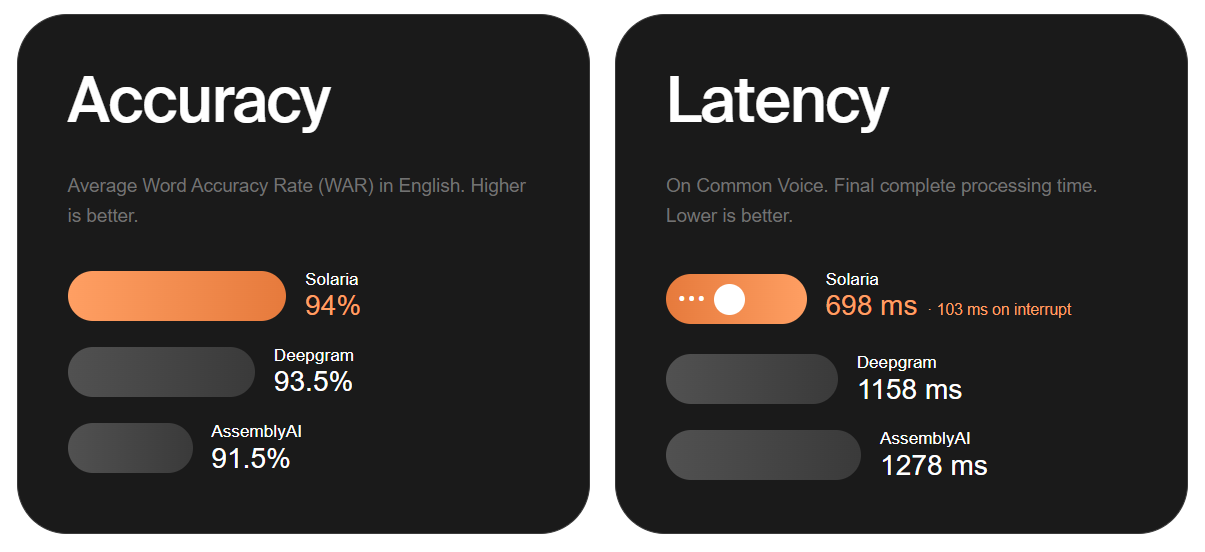
Since publishing this article, Gladia has released Solaria-3 — our newest speech model, built specifically for real-world business audio: noisy, fast-paced, and conversational. On production recordings, Solaria-3 ranks #1 across English and core European languages (EN, FR, DE, ES, IT), beating AssemblyAI, ElevenLabs, Deepgram, Mistral, and Speechmatics. It’s also 26% more accurate than Solaria-1 on real English customer calls. That said, the two models are built to complement each other, not compete. Solaria-1 remains the better choice if you need broad language coverage (100+ languages), code-switching support, real-time streaming, or if your audio is clean, formal, or institutional, such as parliamentary recordings. Solaria-3 is the upgrade if your priority is accuracy on European business audio, call center recordings, or anything noisy and conversational. Not sure which to use?
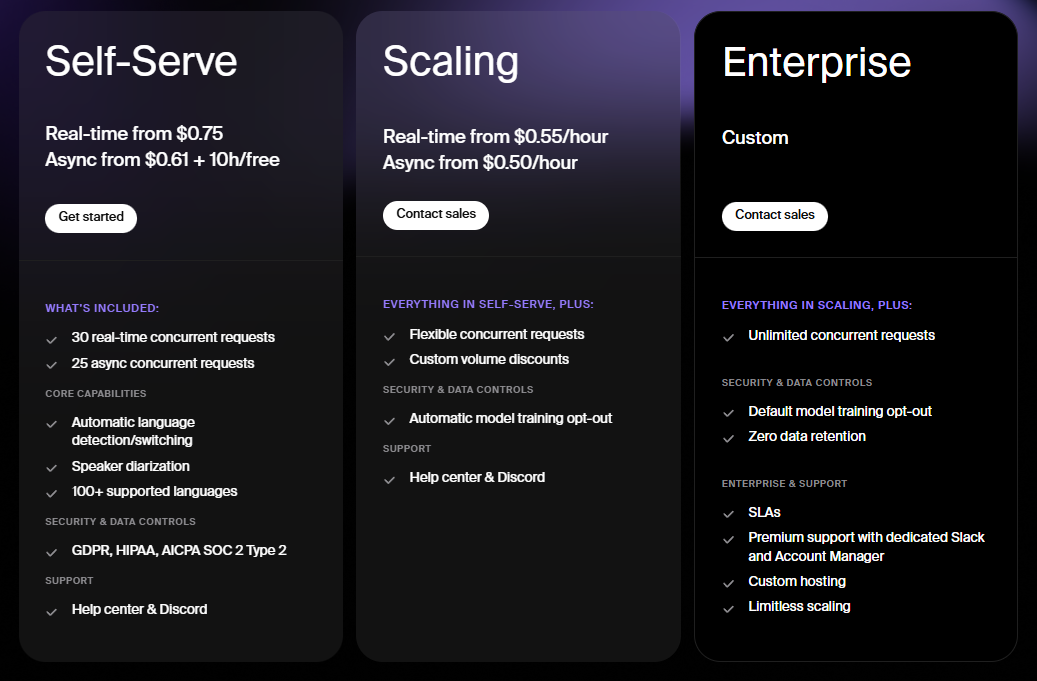
Custom pricing; zero data retention; dedicated Slack support
Best For
Developers who want granular control over feature costs and need mature LLM integration through LeMUR
Teams looking for transparent, all-inclusive pricing with audio intelligence features included, strong multilingual support, and data privacy by default
AssemblyAI pricing: in-depth overview
AssemblyAI operates on a usage-based, pay-as-you-go model without up-front commitments or contracts. The platform charges separately for each base transcription and additional audio intelligence features, allowing users to pay only for what they use. This granular approach offers flexibility for teams who want to optimize costs. For streaming services, billing is based on total session duration. For multichannel audio, each channel is billed separately.
Understanding the pricing models
Before diving into the detailed breakdown, it helps to understand how AssemblyAI and Gladia approach pricing differently:
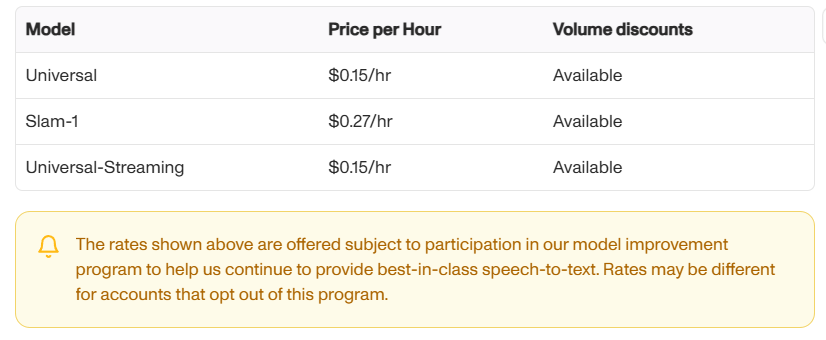
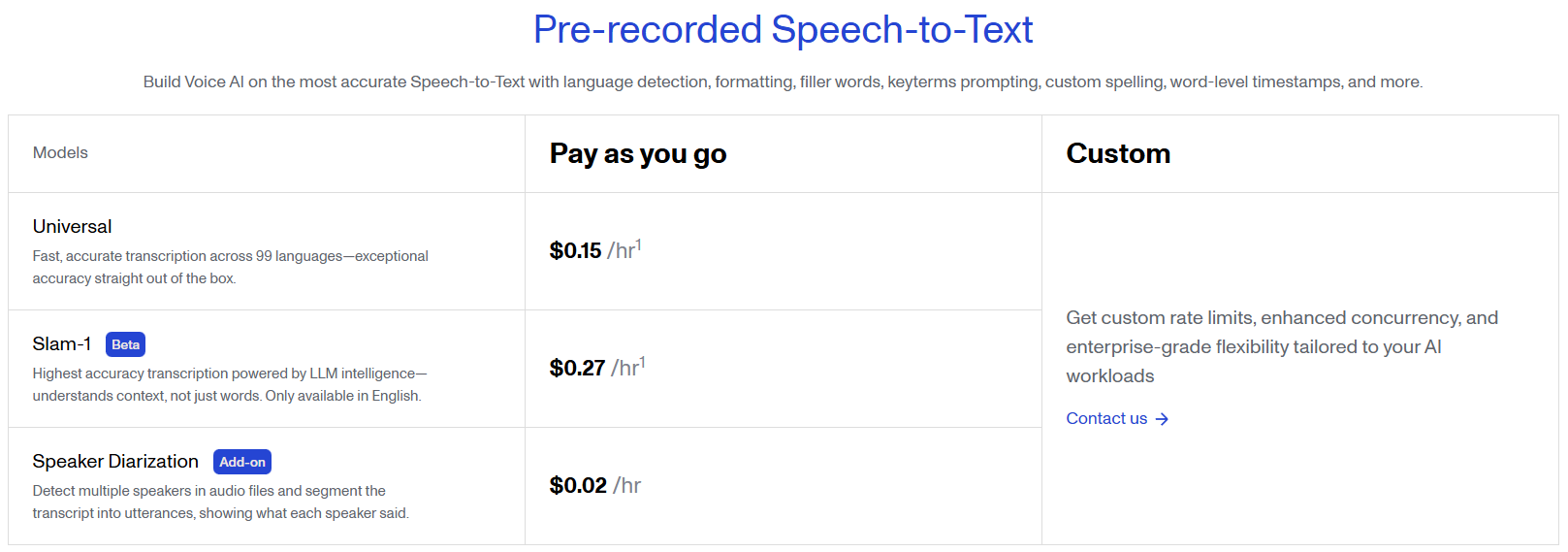
AssemblyAI uses a uniform base rate of $0.15/hr for both pre-recorded (async) and streaming (real-time) transcription.
Additional audio intelligence features like sentiment analysis, summarization, and entity detection are charged as separate add-ons, allowing you to pay only for the capabilities you need. Your actual cost depends on which features you enable. When common audio intelligence features are added (Speaker ID, Sentiment Analysis, Summarization, Entity Detection, and Topic Detection), the effective rate rises to approximately $0.45/hr.
Gladia uses differentiated base rates: $0.61/hr for async and $0.75/hr for real-time on the Self-Serve plan (or $0.50/hr and $0.55/hr, respectively, on the Scaling plan). However, core audio intelligence features like speaker diarization and language detection are included in these base prices rather than being charged separately.
This fundamental difference means that for basic transcription alone, AssemblyAI's lower base rate may be more economical.
But when comparing equivalent feature sets (transcription plus audio intelligence capabilities), the pricing gap narrows significantly: AssemblyAI's \~$0.45/hr with common add-ons is comparable to Gladia's $0.50/hr on the Scaling plan, and Gladia's bundled pricing eliminates the complexity of calculating stacked add-on costs.
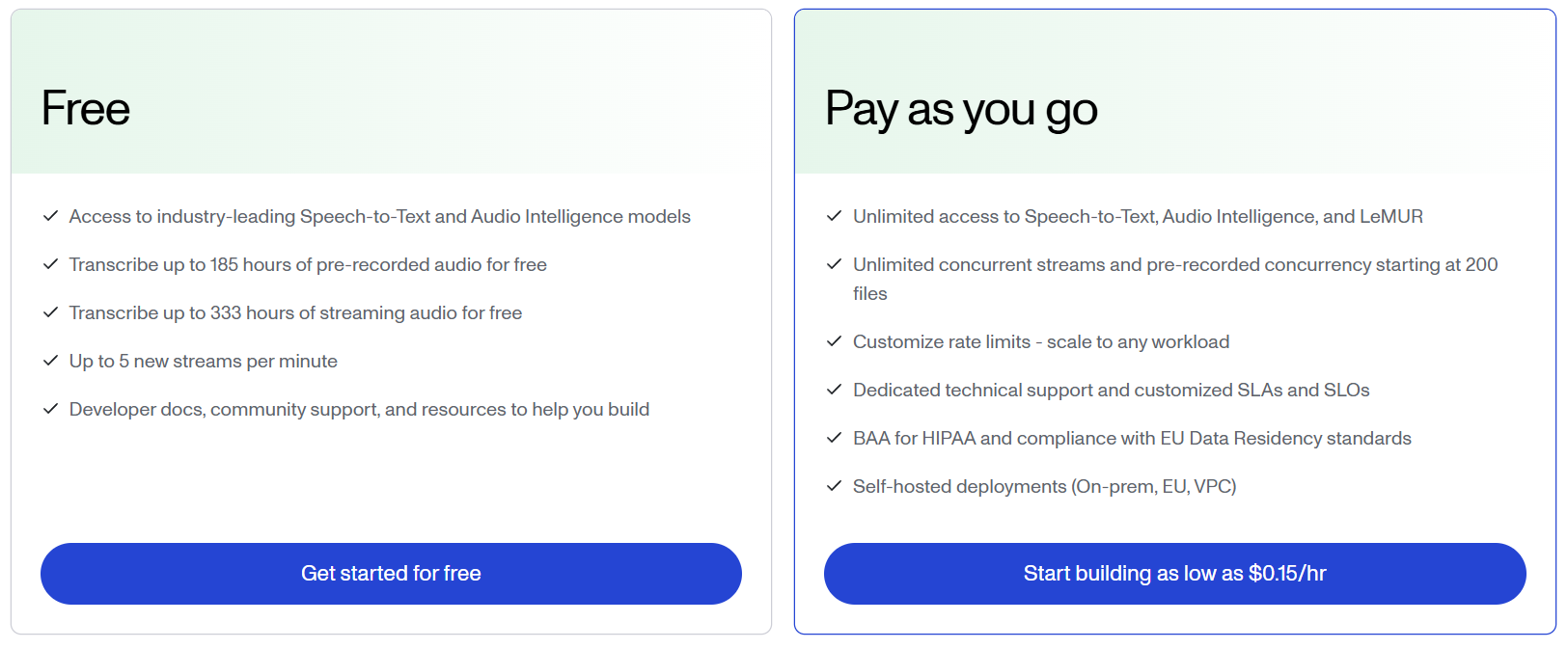
AssemblyAI free tier: $50 in credits
Feature
Details
Credits
$50 one-time allocation
Pre-recorded hours
~185 hours at base rate
Streaming hours
~333 hours at base rate
Concurrent streams
5 new streams per minute
Features
Access to Speech-to-Text and Audio Intelligence models
The free tier provides $50 in credits for new users to test AssemblyAI's capabilities. Unlike subscription models with monthly limits, this is a one-time credit allocation that can be used at any pace. The actual hours you get depend on which features you enable, since each add-on consumes additional credits.
Pros
Cons
✅ No credit card required to start
❌ One-time credits, no monthly refresh
✅ Access to core STT and Audio Intelligence features
❌ Limited streaming concurrency
✅ Flexible usage timeline
❌ Credits deplete faster with add-ons
✅ Broad API access
❌ Some features (like LLM Gateway) excluded
The bottom line 👉 The free tier works well for initial testing and proof-of-concept work, but the one-time credit structure means ongoing development requires moving to paid usage quickly.
AssemblyAI pay-as-you-go: base rates \+ add-ons
The pay-as-you-go model charges a base rate for transcription plus separate fees for each audio intelligence feature. Note that the $0.15/hr base rate applies equally to both pre-recorded (async) and streaming (real-time) transcription. This means a simple transcription costs $0.15/hr, but enabling speaker identification, sentiment analysis, and summarization brings the total to $0.22/hr.
For a more typical production setup that includes Speaker Identification, Sentiment Analysis, Summarization, Entity Detection, and Topic Detection, the total reaches approximately $0.45/hr.
For users needing additional guardrails like PII Redaction and Content Moderation on top of that, costs can reach $0.68/hr or more. Note that these rates are subject to participation in AssemblyAI's model improvement program, and rates may differ for accounts that opt out.
The bottom line 👉 Pay-as-you-go suits users with simple transcription needs or those who can carefully optimize which features to enable. Volume discounts are available for higher usage.
Enterprise plans offer volume-based pricing, custom rate limits, and deployment flexibility for organizations with large-scale needs. This tier includes options for self-hosted deployments for data sovereignty requirements and customized service level agreements.
Pros
Cons
✅ Volume discounts available
❌ Requires sales negotiation
✅ Self-hosted deployment options
❌ Minimum commitments likely
✅ Custom SLAs and SLOs
❌ Implementation timeline for on-prem
✅ Dedicated support
❌ Pricing not publicly listed
The bottom line 👉 Enterprise makes sense for organizations processing high volumes who can negotiate better rates, or those with strict data residency requirements needing self-hosted options.
Where AssemblyAI falls short
While AssemblyAI offers comprehensive speech AI capabilities with strong accuracy, its granular pricing model and platform direction create challenges for certain teams:
Complex cost calculations
Every audio intelligence feature carries a separate per-hour charge
Users must add up the base transcription plus each enabled feature to determine actual costs
A transcription with speaker identification, sentiment, summarization, entity detection, and topic detection costs approximately $0.45/hr compared to the advertised $0.15/hr base rate.
No inclusive feature bundles
Features like sentiment analysis and summarization require additional payment
Teams needing comprehensive audio intelligence pay up to $0.30/hr on top of base transcription
Some competitor platforms include these capabilities in base pricing.
These considerations have led many teams to explore alternatives that offer more predictable pricing with audio intelligence features included.
AssemblyAI alternative: Gladia
Gladia takes a different approach to speech AI pricing by including core audio intelligence features in its base rate.
For teams who find AssemblyAI's add-on pricing complex or need broader real-time multilingual coverage, Gladia offers transparent pricing with features bundled, support for over 100 languages with code-switching in both real-time and async modes, and clear data privacy policies where paid tier audio is not used for model training, without any pricing implications for this protection.
Founded in 2022 with headquarters in both Paris and New York City, Gladia is backed by $20.3 million in funding and serves over 600 enterprise customers, including Aircall and Method Financial. The platform is built on its proprietary Solaria model, designed from the ground up for real-time voice applications with partial latency under 103 milliseconds.
Gladia positions itself as a focused speech AI infrastructure provider, concentrating exclusively on transcription and audio intelligence rather than expanding into end-to-end voice AI solutions. This means teams building voice agents or other products using multiple AI components can use Gladia as a partner rather than a potential competitor in their stack.
Gladia self-serve: $0.61/hr (async) and $0.75/hr (real-time) with all features included
Feature
Details
Async transcription
$0.61/hr
Real-time transcription
$0.75/hr
Free tier
10 hours/month (recurring)
Concurrent requests
30 real-time, 25 async (paid tier)
Included features
Speaker diarization, language detection, 100+ languages, code-switching
Unlike AssemblyAI's add-on model, Gladia's Self-Serve plan includes speaker diarization and other audio intelligence capabilities in the base price. The 10 free hours per month refresh automatically, providing ongoing testing capability rather than a one-time credit allocation. Gladia's Solaria model delivers partial transcripts in approximately 103ms with real-time code-switching across the full 100+ language set.
Pros
Cons
✅ Audio intelligence features included in base price
❌ Base rate includes bundled features vs. à la carte
The bottom line 👉 Self-Serve works well for teams who need speaker diarization, multilingual support, and real-time code-switching included by default, without calculating add-on costs.
Gladia scaling: $0.50/hr (async) and $0.55/hr (real-time) with volume discounts
Feature
Details
Async transcription
From $0.50/hr
Real-time transcription
From $0.55/hr
Concurrent requests
Flexible (customizable)
Additional features
Custom volume discounts, automatic model training opt-out
The Scaling tier reduces per-hour costs while maintaining all Self-Serve features. At $0.50/hr for async transcription with audio intelligence features included, Gladia's Scaling plan is directly comparable to AssemblyAI's \~$0.45/hr rate when common add-ons are factored in, while offering the simplicity of all-inclusive pricing.
Pros
Cons
✅ Lower per-hour rates
❌ Requires contacting sales
✅ Automatic model training opt-out
❌ Volume commitments may apply
✅ Flexible concurrency limits
❌ Smaller ecosystem of integrations
✅ All Self-Serve features included
❌ Less extensive documentation than AssemblyAI
The Bottom Line 👉 Scaling suits growing teams who can commit to volume for better rates while maintaining transparent, predictable pricing.
Gladia enterprise: custom pricing with privacy controls
Enterprise provides maximum flexibility with unlimited concurrency, zero data retention for privacy-sensitive use cases, and dedicated support channels. Gladia's support model includes direct access to technical teams who work closely with customers, an advantage of their focused, startup approach.
AssemblyAI feature value breakdown (vs Gladia)
Pricing philosophy
AssemblyAI's approach: AssemblyAI uses granular add-on pricing with a uniform base rate.
Both pre-recorded (async) and streaming (real-time) transcription cost the same $0.15/hr, with each audio intelligence feature adding $0.02 to $0.15/hr. This gives users precise control but requires calculating total costs.
For example, a transcription with speaker identification, sentiment analysis, summarization, entity detection, and topic detection costs approximately $0.45/hr, regardless of whether you're processing pre-recorded files or live streams.
Gladia's approach: Gladia uses differentiated base rates for each mode: $0.61/hr for async and $0.75/hr for real-time transcription on the Self-Serve plan (or $0.50/hr and $0.55/hr on the Scaling plan).
Core audio intelligence features (including speaker diarization, language detection, sentiment analysis, summarization, entity detection, and more) are bundled into these base prices. Users know their costs upfront without adding line items.
🪙 Value comparison: For teams needing only basic transcription, AssemblyAI's $0.15/hr base rate offers savings. For teams needing standard audio intelligence features, the pricing gap narrows: AssemblyAI's \~$0.45/hr with common add-ons is comparable to Gladia's Scaling plan at $0.50/hr async. Gladia's bundled approach eliminates cost calculation complexity and provides predictable bills.
Gladia's approach: Gladia supports over 100 languages in both async and real-time modes, with code-switching capability across the full language set. The platform's European heritage, with headquarters in Paris and New York, means multilingual support has been foundational from the start rather than added later. Gladia's Solaria-1 model includes 42 languages that are completely unsupported by some competitors.
🪙 Value comparison: For English-primary or single-language use cases, both platforms perform well. For multilingual applications where users may speak in any of dozens of languages or switch between languages mid-conversation, Gladia's broader language support is a significant advantage.
Data privacy
AssemblyAI's approach: AssemblyAI offers SOC 2, GDPR, and HIPAA compliance. Enterprise plans include self-hosted deployment options for data sovereignty. AssemblyAI has a model improvement program, and their documentation notes that published rates are subject to participation in this program, with rates potentially differing for accounts that opt out. A documented opt-out process is available.
Gladia's approach: Gladia's paid tiers (Scaling and Enterprise) are not subject to data being used for model training, and this protection is included in standard pricing without opt-out processes or potential pricing implications. The Enterprise tier offers zero data retention. Free tier users should note that their audio may be used for model training. For Gladia, data privacy is treated as a default rather than a premium add-on.
🪙 Value comparison: Both platforms offer compliance certifications. The key difference is philosophical: AssemblyAI ties its published pricing to model improvement program participation, while Gladia includes data privacy protection in its standard paid tier pricing without pricing penalties.
Real-time performance
AssemblyAI's approach: AssemblyAI's Universal-Streaming delivers approximately 300ms latency with immutable transcripts and intelligent endpointing. The streaming model uses a turn-based approach optimized for voice agent applications.
Gladia's approach: Gladia's Solaria-1 model was designed as a real-time-first architecture, delivering partial latency around 103ms. The platform supports real-time code-switching and entity recognition across 100+ languages simultaneously.
🪙 Value comparison: Both platforms offer competitive real-time latency for voice agent use cases. AssemblyAI's streaming is limited to 6 languages, while Gladia supports 100+ in real-time, making Gladia better suited for multilingual voice applications.
Advanced AI features
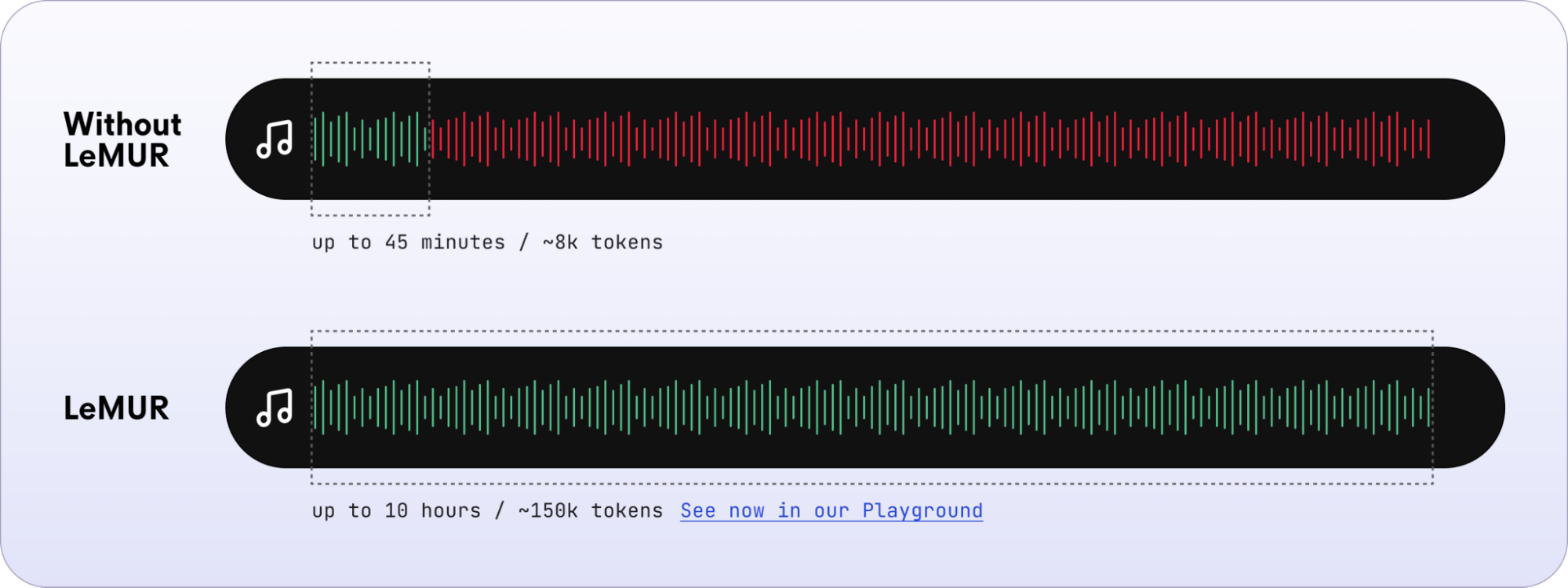
AssemblyAI's approach: AssemblyAI offers LeMUR, a mature framework for applying large language models to transcribed audio. This enables question-answering, custom summaries, and action item extraction from recordings up to 100 hours long. LeMUR is a production-ready feature with extensive documentation.
Gladia's approach: Gladia offers summarization, sentiment analysis, and an Audio to LLM feature (currently in alpha) that allows custom prompts to be applied to transcripts.
🪙 Value comparison: AssemblyAI's LeMUR is the more mature LLM integration, making it a better choice for teams prioritizing LLM-powered audio analysis today. Gladia's Audio to LLM provides similar functionality but is earlier in development.
Platform direction
AssemblyAI's approach: AssemblyAI has positioned itself as a Voice AI platform, expanding beyond core transcription into LLM integration (LeMUR), guardrails, and comprehensive speech understanding features.
Gladia's approach: Gladia positions itself as a focused speech AI infrastructure provider, deliberately remaining vertical in the transcription and audio intelligence space. This pure-player approach means Gladia doesn't compete with customers building voice agents or other products that combine multiple AI components.
🪙 Value comparison: Teams wanting an all-in-one Voice AI platform may prefer AssemblyAI's broader feature set. Teams building products that combine STT with other AI services, and who want their infrastructure provider to remain a partner rather than a potential competitor, may prefer Gladia's focused approach.
AssemblyAI pricing FAQs
Is AssemblyAI free to use?
AssemblyAI provides $50 in free credits for new users, which covers approximately 185 hours of pre-recorded transcription at the base rate or 333 hours of streaming. However, this is a one-time allocation rather than a recurring monthly free tier. Once credits are exhausted, a payment method is required.
How does AssemblyAI's add-on pricing work?
AssemblyAI charges a base rate for transcription ($0.15/hr for both pre-recorded and streaming modes) plus separate per-hour fees for each audio intelligence feature enabled.
Note that basic speaker diarization is included in the Universal model; the $0.02/hr add-on is for Speaker Identification, which maps speakers to real names. Sentiment analysis adds $0.02/hr, summarization adds $0.03/hr, entity detection adds $0.08/hr, and topic detection adds $0.15/hr.
Adding all of these common features brings the effective rate to approximately $0.45/hr.
Which is more cost-effective: AssemblyAI or Gladia?
For basic transcription only, AssemblyAI's base rate of $0.15/hr (the same for both async and real-time) is lower than Gladia's rates of $0.61/hr async or $0.75/hr real-time on the Self-Serve plan.
However, Gladia's pricing includes audio intelligence features like speaker diarization, sentiment analysis, summarization, entity detection, and more, while AssemblyAI charges separately for each. When comparing equivalent feature sets, AssemblyAI's effective rate rises to approximately $0.45/hr, which is comparable to Gladia's Scaling plan at $0.50/hr for async. The best choice depends on which features you actually need: à la carte flexibility from AssemblyAI or bundled predictability from Gladia.
Does Gladia offer similar features to AssemblyAI?
Yes, Gladia offers speech-to-text, speaker diarization, sentiment analysis, summarization, and named entity recognition through its Solaria-1 model.
Gladia also has an Audio to LLM feature (in alpha) that provides LLM-powered analysis similar to AssemblyAI's LeMUR, though LeMUR is more mature. Gladia differentiates with broader real-time multilingual support (100+ languages vs. 6\) and data privacy included in paid tier pricing without opt-out requirements.
Does AssemblyAI use my audio data to train its models?
Yes. AssemblyAI offers $50 in one-time credits without requiring a credit card. Gladia provides 10 free hours per month that refresh automatically. Both allow testing core features before committing to paid usage.
How does real-time language support compare?
AssemblyAI's real-time streaming supports 6 languages: English, Spanish, French, German, Italian, and Portuguese (with non-English in beta). Their async transcription supports 99+ languages. Gladia supports 100+ languages in both real-time and async modes, with code-switching available across the full language set.
Final verdict: AssemblyAI vs Gladia
The choice between AssemblyAI and Gladia depends on your specific requirements for features, pricing structure, multilingual support, and data handling preferences:
👍 Choose AssemblyAI if:
You want granular control over which features you pay for.
You need base transcription at $0.15/hr with the option to add only the specific audio intelligence features you require (noting that common add-ons bring the effective rate to approximately $0.45/hr).
Your team wants to optimize costs by enabling only necessary features.
You need mature LLM integration via LeMUR for advanced audio analysis.
Your use case primarily involves English or a limited set of languages (6 languages supported in streaming).
Your team is comfortable calculating total costs across multiple features.
You require production-ready LLM integration for audio analysis.
You want transparent, inclusive pricing with no hidden add-on costs.
You need async transcription at $0.61/hr or real-time at $0.75/hr (Self-Serve), or $0.50/hr and $0.55/hr respectively (Scaling), with speaker diarization, language detection, sentiment analysis, summarization, entity detection, and other standard audio intelligence features included.
Your applications require real-time performance with sub-103ms partial latency (powered by the Solaria-1 model).
You operate in multilingual environments, supporting 100+ languages with code-switching.
Your organization values data privacy included by default, without opt-out processes or pricing implications.
You prefer a focused speech AI infrastructure that won't compete with your voice product development.
The fundamental difference extends beyond pricing philosophy. AssemblyAI is expanding into a broader Voice AI platform with comprehensive features, while Gladia remains focused on speech AI infrastructure. Both platforms deliver strong accuracy and performance, but the choice depends on whether you prefer granular cost control with mature LLM features or bundled pricing with broader real-time multilingual support and privacy included by default.
Contact us
Your request has been registered
A problem occurred while submitting the form.
Read more
Speech-To-Text
MiFID II and FCA call recording: compliance for voice transcription in finance
Speech-To-Text
Why speech-to-text accuracy matters upstream of your LLM