Lorem ipsum dolor sit amet, consectetur adipiscing elit, sed do eiusmod tempor incididunt ut labore et dolore magna aliqua. Ut enim ad minim veniam, quis nostrud exercitation ullamco laboris nisi ut aliquip ex ea commodo consequat. Duis aute irure dolor in reprehenderit in voluptate velit esse cillum dolore eu fugiat nulla pariatur.
Gladia to join OVH Groupe, accelerating Europe's sovereign voice AI ambitions
PARIS, France — Sept 21, 2026 — Gladia, the AI audio infrastructure provider trusted by more than 300,000 developers and 2,000 enterprise customers worldwide, announced July 31st, that it has been acquired by OVH Groupe, the parent company of OVHcloud and Europe's leading sovereign cloud provider.
Migrating from Azure Speech to Gladia: a step-by-step switching guide
TL;DR: Migrating from Azure Speech to Gladia removes the overhead of custom training pipelines and fragmented per-feature billing. Azure routes diarization, translation, and sentiment through separate services with separate billing meters. We bundle all audio intelligence into one per-hour rate on Starter and Growth plans. Solaria-3 ranks #1 for real-world European business audio, Solaria-1 covers 100+ languages with native code-switching. Both deliver out-of-the-box accuracy that eliminates custom training for most production audio. Most engineering teams complete the API refactoring in under 24 hours.
How to evaluate a speech-to-text API: a technical buyer's framework
TL;DR: Choosing an STT API on vendor benchmarks alone is how teams end up with transcription that looks fine in staging and breaks on production audio. A rigorous evaluation requires building a test set from your own calls, measuring word error rate (WER) on your specific audio distribution, stress-testing latency under concurrent load, and auditing data retraining terms before signing. This guide gives you a reusable engineering blueprint to run that evaluation end-to-end, the same methodology behind our own open async benchmark, which covers 7 datasets and 74+ hours of audio across 8 providers.
How Attention closes more deals and powers smarter AI sales workflows with Gladia
Published on Sep 25, 2025
The revenue tech stack is evolving fast. What used to be manual note-taking and inconsistent CRM updates is giving way to AI-powered workflows that turn every conversation into structured, actionable data. At the core of that shift is transcription: if the words aren’t captured quickly and accurately, everything downstream falls apart.
Attention, an AI platform for sales teams, blends insights (like scorecards and conversation analytics) with workflows (like CRM autofill and automated follow-ups). Because all of that depends on high-quality call recording and transcription, Attention benchmarks providers regularly and chose Gladia to power the speech-to-text layer.
We visited Attention's NYC headquarters and sat down with Matthias Wickenburg, the company's CTO & co-founder, to discuss what made Gladia a perfect choice to power their AI agents. Here’s what he had to say about how Attention uses Gladia to win pilots, improve retention, and support global, multilingual teams.
About Attention
Attention is a Series A, New York-based AI startup, founded by Anis Bennaceur and Matthias Wickenburg in 2021. Attention builds AI sales agents that record your team’s sales touchpoints (meetings, emails, calls, CRMs, and more), then automate the busywork: follow-ups, next steps, CRM updates, coaching scorecards, and other revenue workflows.
Their catalog includes focused agents such as CRM auto-update, competitive intelligence tracking, lead qualification enrichment, and more. Attention’s AI sales agents give RevOps a consistent foundation while keeping reps focused on selling.
In short, Attention captures conversation data and turns it into repeatable actions across the revenue stack.
Key takeaways (TL;DR)
Everything is downstream from transcription. Attention’s key features such as CRM auto-fill, coaching scorecards, and large-scale conversation insights all rely on high-quality call recording and transcription. If the initial transcript isn’t strong, the rest of the pipeline suffers.
Benchmarks guide the stack. Every three months, Attention runs a comprehensive internal benchmark to evaluate the strongest models and keep accuracy and reliability high.
Open source wasn’t production-ready for their scale. Plugging in a heavyweight model like Whisper looked attractive, but serving it at scale to tens of thousands of users simultaneously introduced too much operational overhead—so they chose an API-first path.
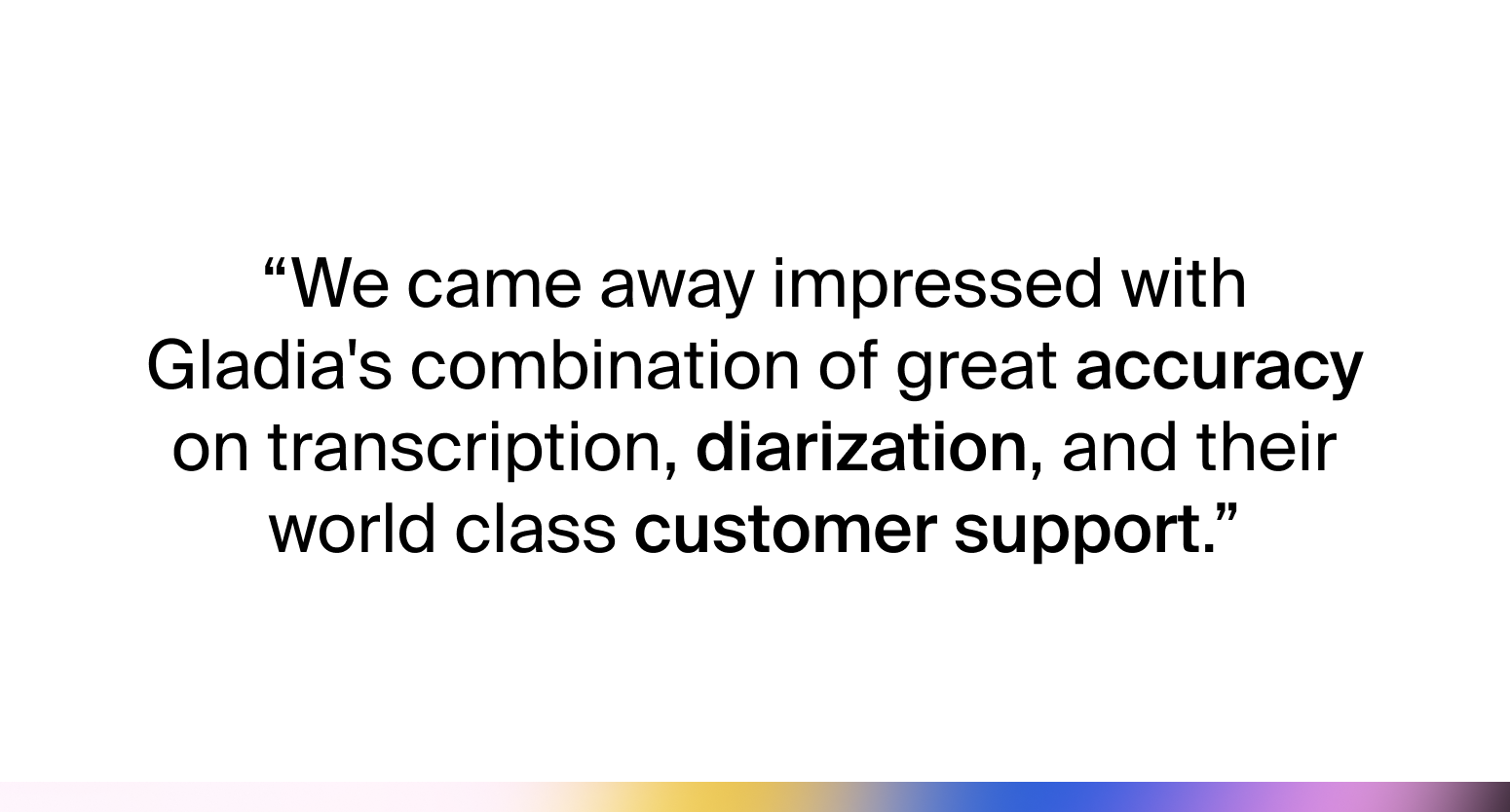
Gladia delivered where it counts. Accuracy, diarization, and world-class support were decisive, and one of the first things that made Attention stand out in prospect pilots and POCs.
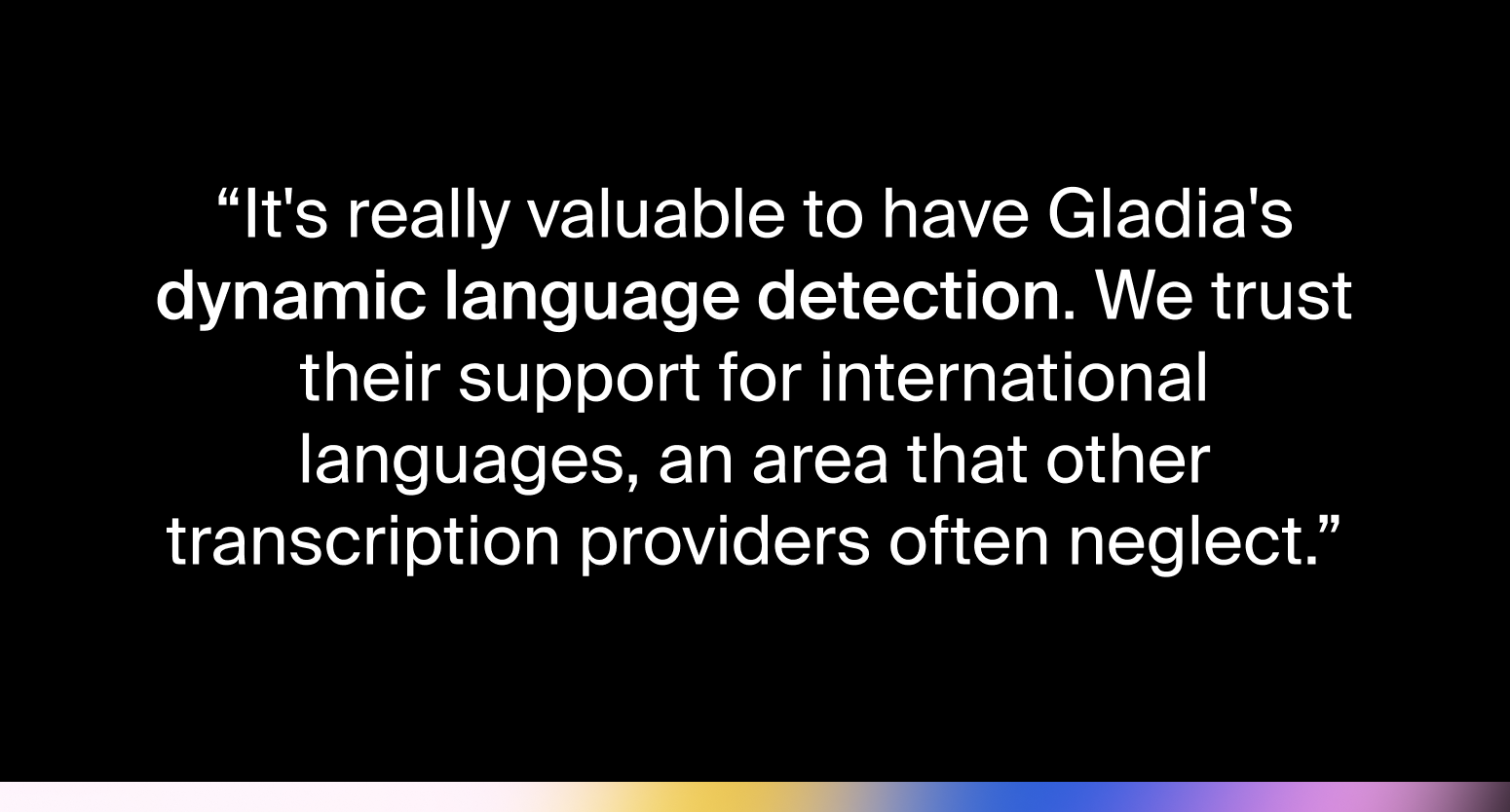
Built for global teams.Dynamic language detection handles conversations that switch between languages in the same call—an international reality for many of Attention’s customers.
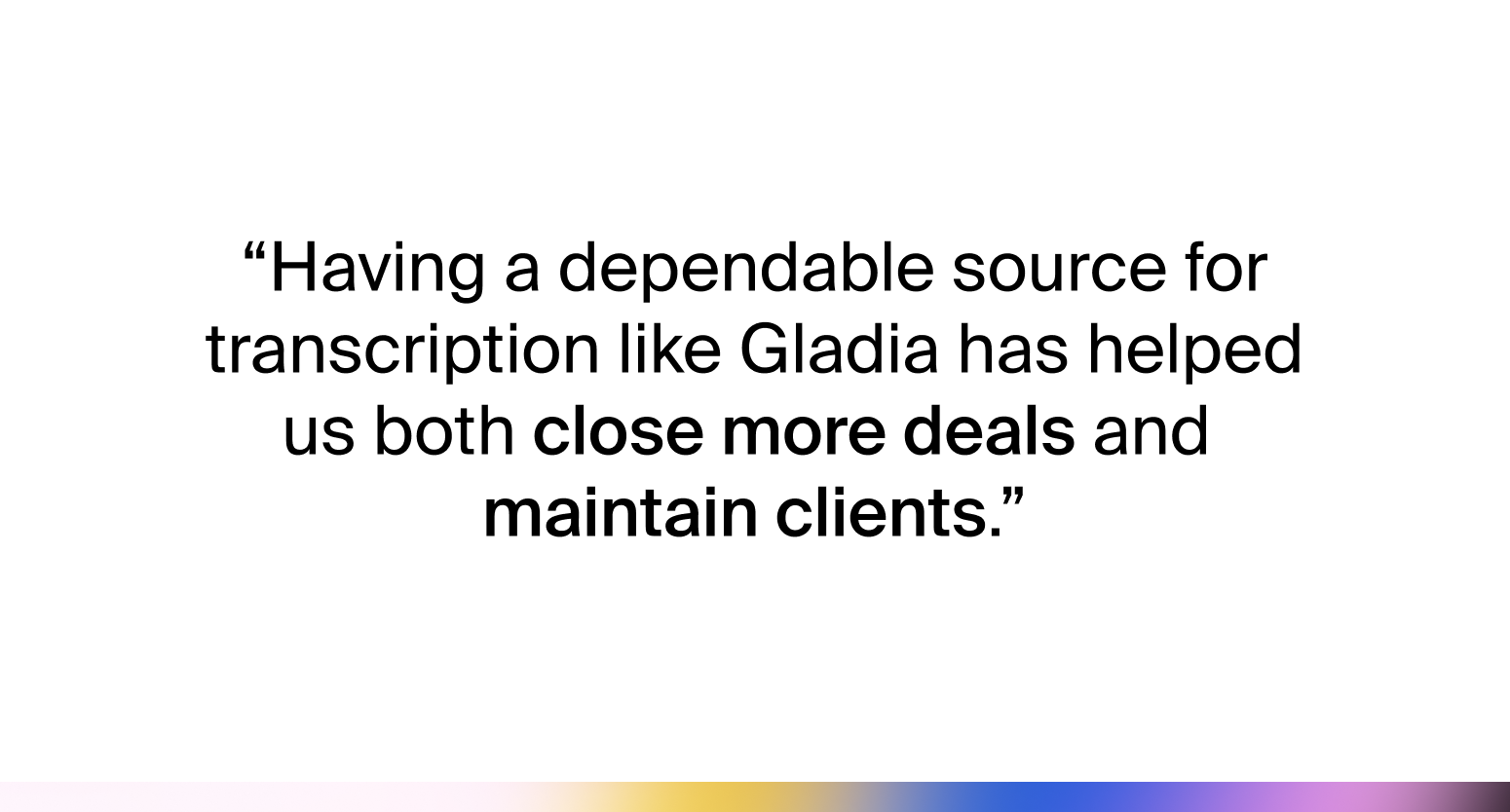
Business impact beyond the POC. A dependable transcription layer means better keyword/competitor detection, stronger downstream insights, and both higher win rates and better retention.
Challenge: Enterprise-grade transcription that scales
Attention needs a transcription layer that is:
Accurate from the first word. If a transcript misses a keyword or competitor name, all the downstream insights, automations, and deliverables are weakened.
Operationally ready for real-world concurrency. The platform must deliver in production, at scale, for tens of thousands of users simultaneously, not just in lab conditions.
Maintainable without heavy infra. Like many tech companies, Attention first attempted the open source route, but quickly realized that self-hosting and scaling a highly accurate and reliable speech-to-text layer would be extremely difficult with a heavyweight model like Whisper.
Solution: Gladia’s speech-to-text API
Gladia provides the speed, accuracy, and scalability Attention needs, plus:
Diarization that separates speakers cleanly, so notes, actions, and scorecards can be tied to the right person.
Dynamic language detection with robust multilingual support, essential for calls that switch between English, French, and Spanish without warning.
Responsive, world-class customer support that shortens the path from pilot/POC to stable, production-grade rollouts.
For Attention, this directly drives outcomes: better POC experiences, higher win rates, and stronger retention once live.
Use cases
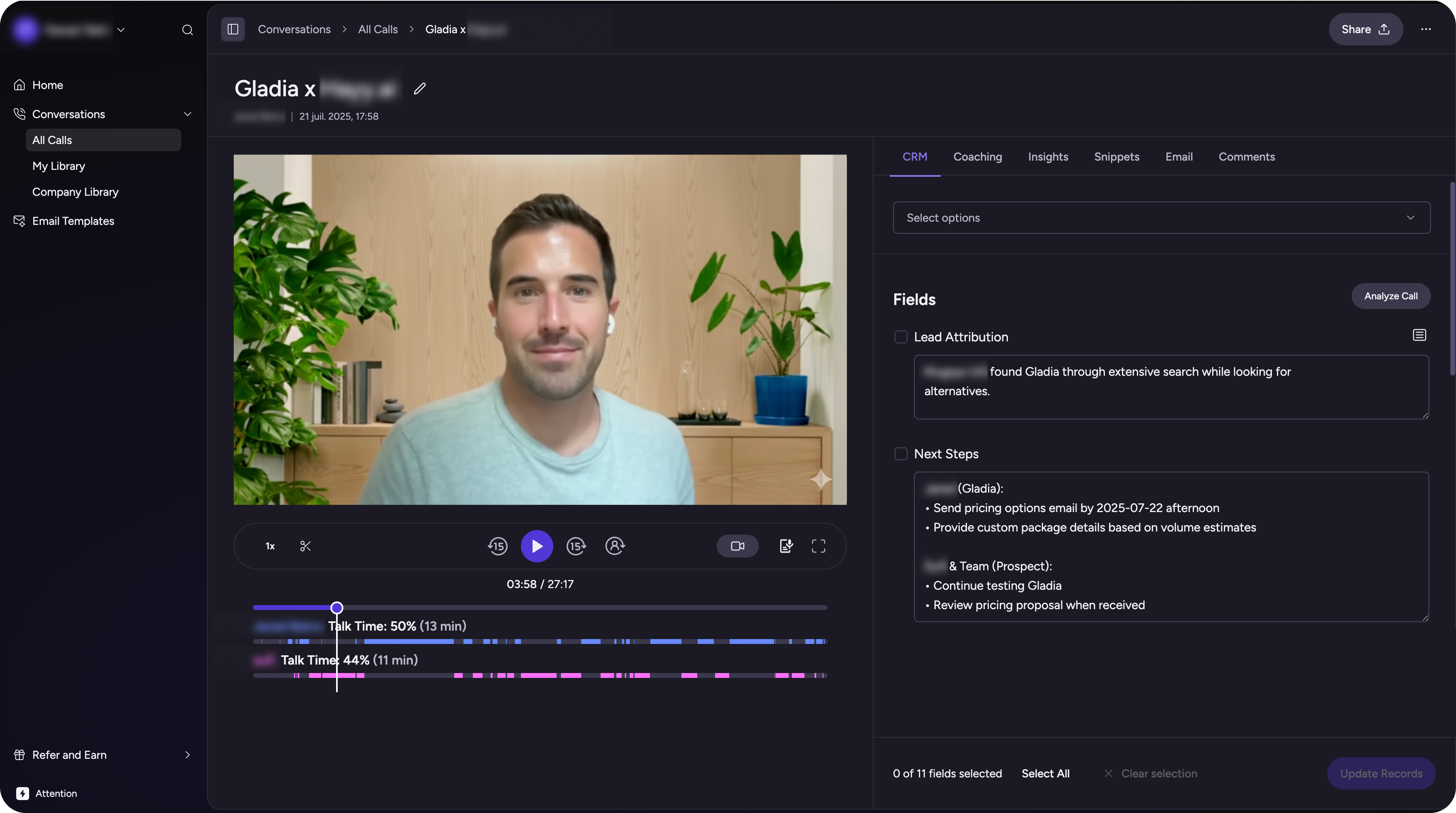
Automated CRM autofill & workflows. High-quality transcripts populate fields and next steps reliably, so reps aren’t retyping the call and RevOps gets consistent data.
Coaching scorecards and QA. Attention’s AI coaching depends on precise recognition of phrases, objections, and competitor mentions; better transcripts make better coaching.
Conversation intelligence at scale. When analyzing thousands to hundreds of thousands of conversations, transcript quality determines the accuracy of insights and trend detection.
International coverage out of the box. Many of Attention’s customers have highly international teams that often code-switch between multiple languages (e.g. English, French, and Spanish) within the span of one conversation. With Gladia’s dynamic language detection, mixed-language calls are captured correctly even when speakers code-switch mid-conversation.
Why Attention chose Gladia
Accuracy that preserves meaning. Correctly catching keywords and competitor names keeps downstream sales analytics trustworthy.
Production reliability at scale. An API designed to serve large user bases concurrently avoids the operational burden of self-hosting heavyweight models.
Best in class multilingual support. With Gladia’s code switching capabilities, real-life multilingual transitions are handled seamlessly without the need for heavy manual setup.
A partner, not just a vendor.Gladia's reactive support helps Attention ship faster and solve edge cases during pilots and expansions.
Results: Better pilots, higher retention
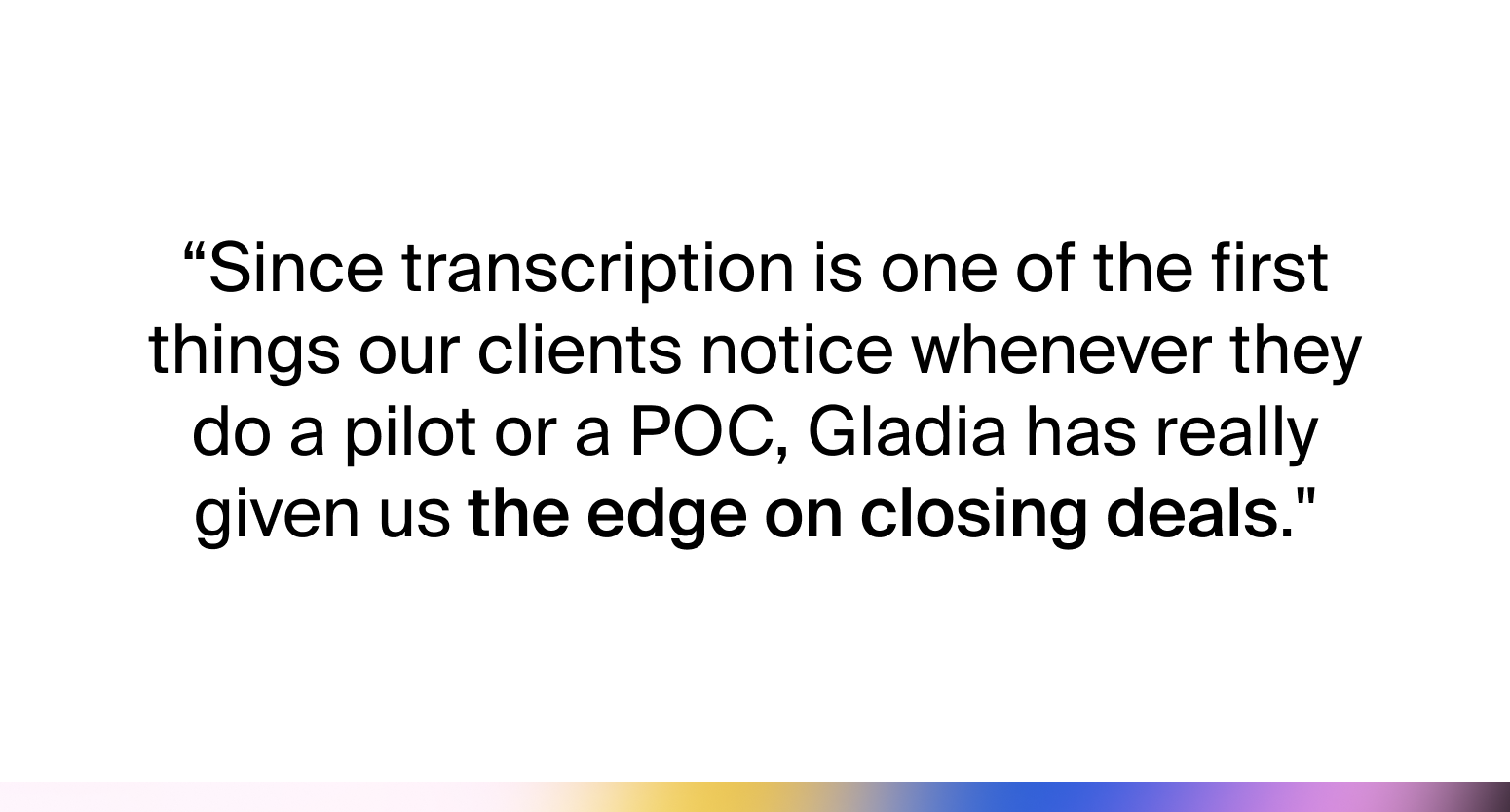
Immediate credibility in POCs. Because transcription is what prospects notice first, stronger accuracy translates into higher conversion from pilot to closed-won.
Dependable day-to-day operations. A reliable speech layer keeps features performing consistently and helps retain clients long after go-live.
Cleaner signals for RevOps and managers. Fewer transcription errors mean more consistent workflows, better coaching signals, and more confident decision-making.
About Gladia
Gladia provides a speech-to-text and audio intelligence API used to power AI-powered voice agents, note-taking apps, call-center platforms, and media products. Our real-time and async offerings deliver highly accurate transcription, speaker diarization, auto-translation, and insights with production-grade performance, including dynamic language detection for 100+ languages.


.png)