Lorem ipsum dolor sit amet, consectetur adipiscing elit, sed do eiusmod tempor incididunt ut labore et dolore magna aliqua. Ut enim ad minim veniam, quis nostrud exercitation ullamco laboris nisi ut aliquip ex ea commodo consequat. Duis aute irure dolor in reprehenderit in voluptate velit esse cillum dolore eu fugiat nulla pariatur.
MiFID II and FCA call recording: compliance for voice transcription in finance
TL;DR: Financial firms operating under MiFID II and FCA jurisdictions must maintain searchable, high-accuracy records of all client-related voice communications, including remote and mobile calls under FCA Market Watch 66. Engineering and product teams building for these obligations typically implement dedicated cloud infrastructure with defined data residency, controls that prevent customer audio from being used to retrain models on Growth and Enterprise plans, and transcription accurate enough that the resulting records hold up under regulatory review. Transcription and speaker attribution errors are not product quality issues in this context. They are audit trail failures, and regulators treat them as such.
Why speech-to-text accuracy matters upstream of your LLM
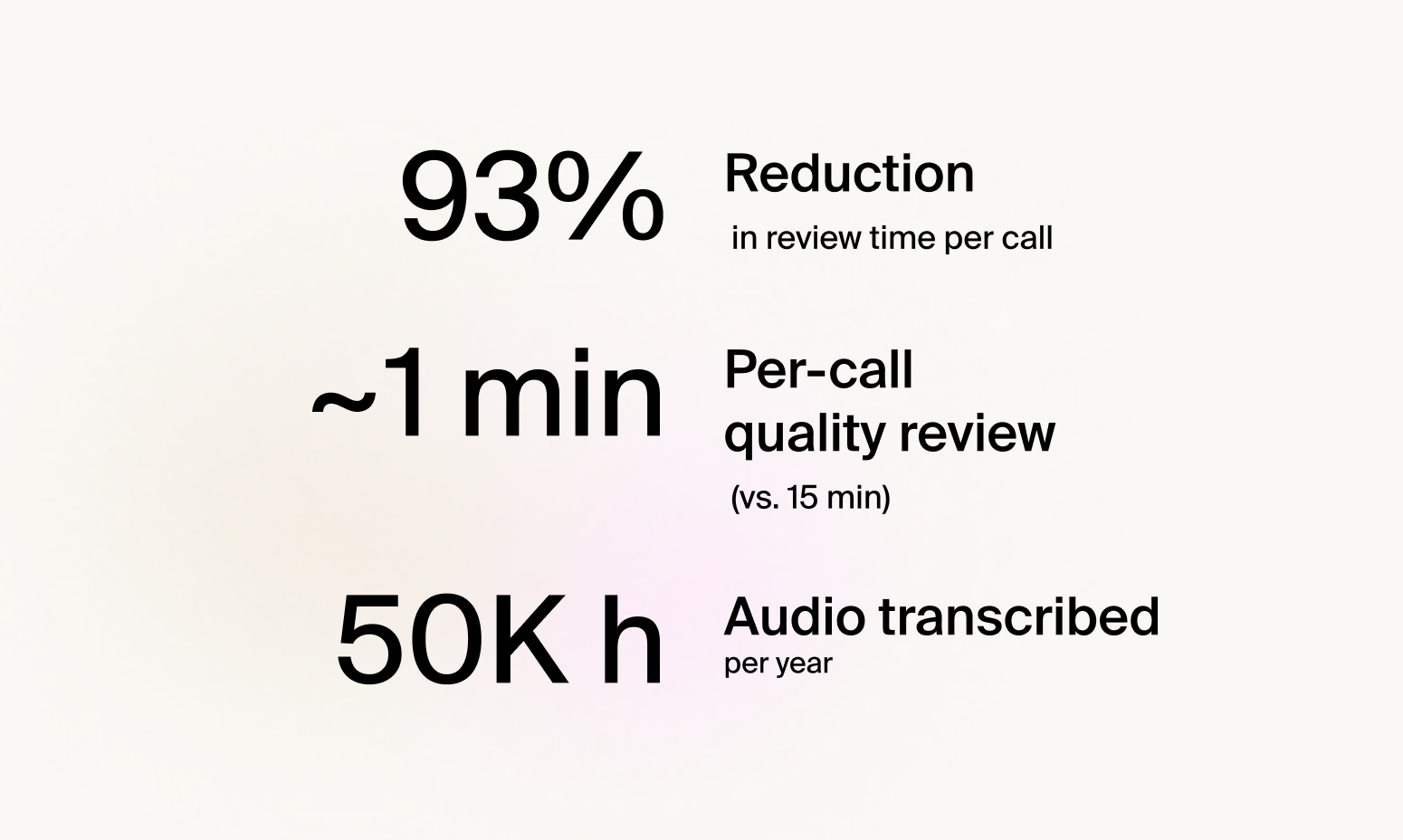
TL;DR: Downstream LLM performance is ceiling-bounded by upstream transcription accuracy. A transcript with a meaningful error rate doesn't produce proportionally degraded summaries or CRM entries. It produces outputs where hallucinated names, inverted logic, and misattributed speaker turns compound silently into every downstream system that reads them. Prompt engineering cannot recover information the STT layer never captured. Gravite cut call quality review time by 93%, from 15 minutes to 1 minute per call, once transcript accuracy was high enough to trust the output without manual verification.
TL;DR: Telephony audio is constrained to 8kHz narrowband frequencies, stripping away the high-frequency spectral energy that generic 16kHz STT models require. Standard upsampling cannot recover phonemes that were never captured at the source, leading to transcription errors that compound silently into downstream NLU failures. Solaria-3 ranks #1 on Switchboard, the most challenging conversational telephony dataset, ahead of AssemblyAI, ElevenLabs, Deepgram, Mistral, and Speechmatics, ensuring your downstream LLM pipelines receive clean, structured data from real-world noisy call audio.
How Gravite reduced call quality review time by 93% with Gladia
Published on Jul 1, 2026
Anna Jelezovskaia
Quality monitoring is one of the most time-consuming processes in any contact center operation. Traditionally, supervisors would manually listen back to recorded calls — a practice known as "picking" or shadow listening — to evaluate agent performance, flag compliance issues, and identify coaching opportunities. For large enterprises handling thousands of calls daily, the math simply does not scale.
Gravite was built to change that. By combining AI-driven analysis with a flexible no-code workflow engine, the platform transforms raw call recordings into structured quality scores — automatically, at scale. But this entire pipeline rests on one foundational capability: accurate speech-to-text transcription.
That is where Gladia comes in. Since its earliest days, Gravite has relied on Gladia's speech-to-text API as the sole transcription layer powering its platform. Here is how that partnership has helped Gravite cut quality review time by 93%.
About Gravite
Gravite is a French B2B SaaS platform focused on AI-powered quality management for customer service and sales teams. Founded two and a half years ago, the company works with large enterprises across retail, banking, and insurance — clients like Intersport, large French banking groups, and major insurance providers.
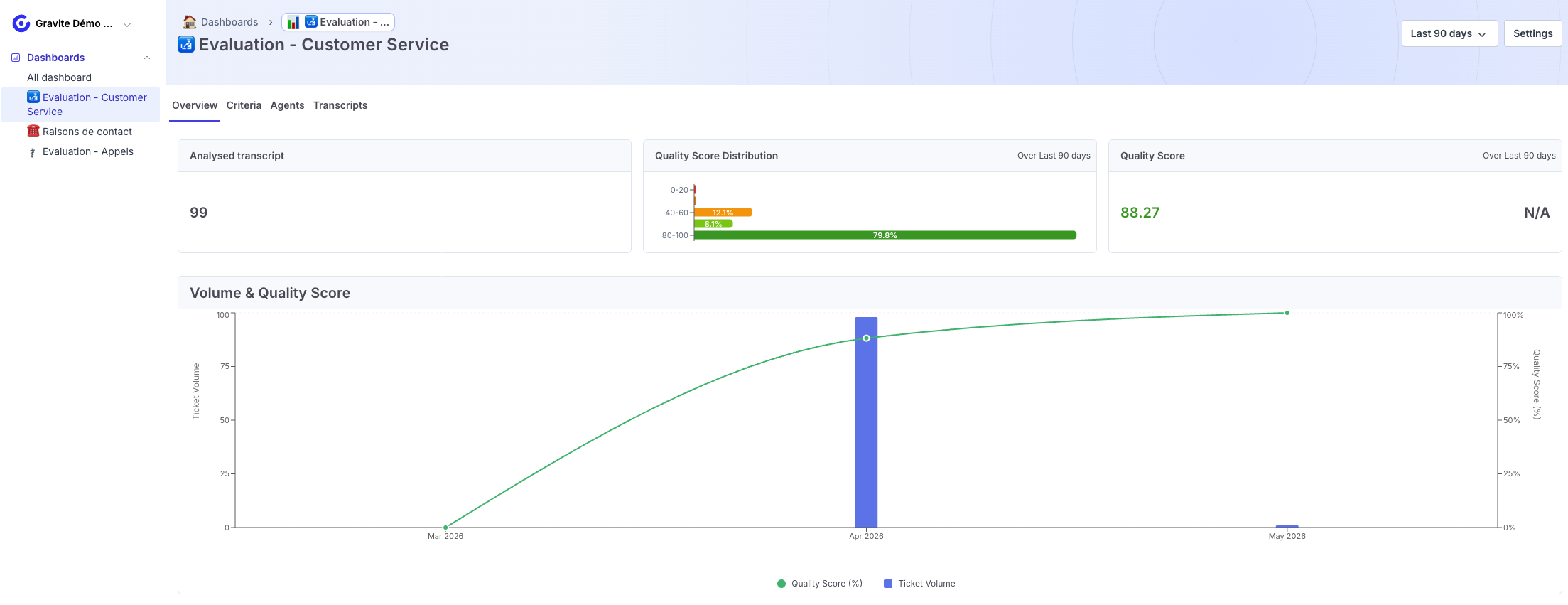
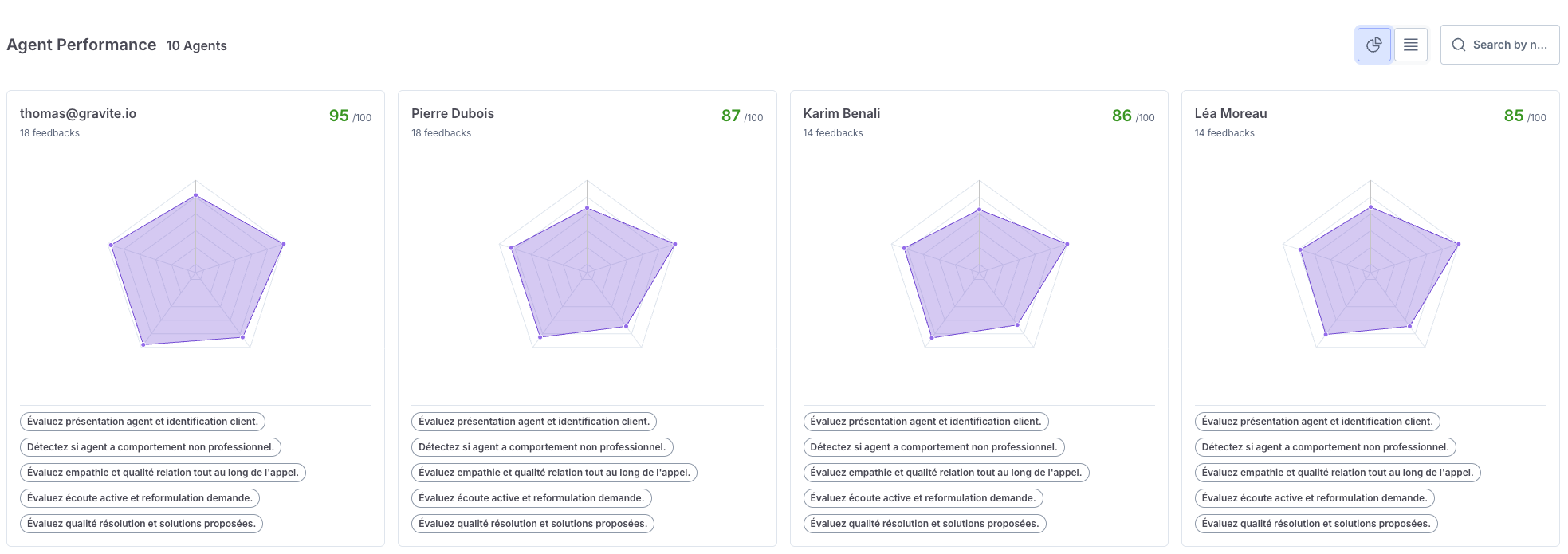
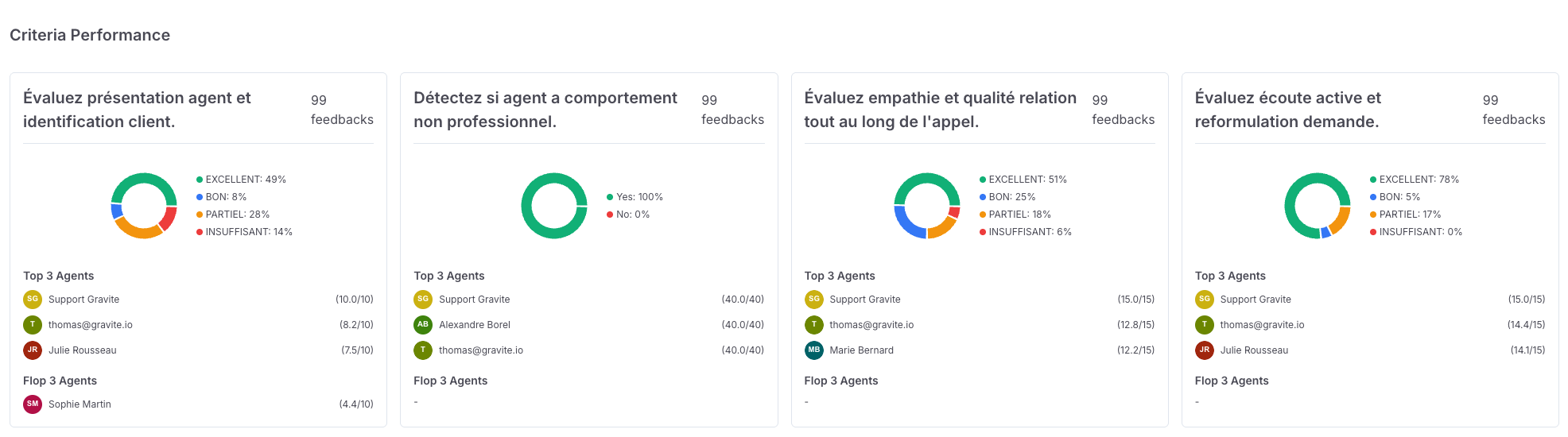
The platform connects to a company's existing telephony infrastructure (Diabolocom, Avaya, Cisco, Genesys, and others), ingests call recordings, and runs them through a customizable analysis engine. Managers and team leads can build quality criteria without writing code — a workflow resembling tools like Make or Zapier — and get real-time dashboards showing how each agent performs across every metric.
Gravite obtained ISO 27001 certification in May 2026, a milestone that reflects its commitment to data security for enterprise clients. The company targets the French market primarily, with active expansion into other European markets including Germany, Italy, and Spain.
Challenge: Scaling quality monitoring without manual listening
Before platforms like Gravite, quality monitoring in contact centers followed a labor-intensive pattern: supervisors would select a sample of calls, listen to each one in full, manually score the agent against a checklist, and compile feedback.
For an average call of eight minutes, a single review session could consume fifteen minutes or more of a supervisor's time — eight minutes of listening plus several minutes to evaluate and document each criterion.
At scale, this approach is unsustainable. Large contact centers may field thousands of calls per day, and manual sampling means the vast majority of interactions go unreviewed entirely. Coaching is reactive rather than systematic, and trends only surface after problems have already taken hold.
Gravite's answer was to automate the entire workflow: receive the call audio, transcribe it, run it through AI-driven analysis criteria, and surface results in a comprehensive dashboard, all without a human in the loop. But this pipeline is only as good as its first step. Without a reliable, accurate transcript, the downstream analysis breaks down entirely.
Solution: Gladia's speech-to-text API as the transcription layer
Gravite integrated Gladia's asynchronous speech-to-text API from the very beginning of its product development. The flow is straightforward: call audio is pulled from the client's telephony system, sent to Gladia for transcription, and the resulting transcript lands in Gravite's data layer, ready for downstream analysis.
From there, Gravite's no-code workflow engine takes over. Teams configure analysis flows with custom triggers (e.g., calls longer than 90 seconds from a specific telephony source) and build quality criteria as natural-language questions — "Did the agent introduce themselves clearly at the start of the call?" The AI reads the transcript, answers each question, and scores the interaction automatically.
How Gravite uses Gladia
Asynchronous transcription of inbound and outbound call recordings
Feeds a no-code quality workflow builder with AI-scored criteria
Powers real-time dashboards showing per-agent performance across all quality metrics
Enables instant Slack alerting when a call falls below a defined quality threshold
Supports multilingual transcription across French, German, Italian, and Spanish for multinational clients
Why Gravite chose Gladia
Gravite's decision to build on Gladia was driven by a combination of market focus, technical quality, and trust.
French-first, with European reach: Gravite targets the French enterprise market, and from the outset, the team wanted to work with a French provider — both for superior transcription quality in French and for the data sovereignty expectations of large French clients.
Gladia, headquartered in Paris and NYC, fit that requirement naturally. As Gravite expands into European markets, Gladia's strength in other European languages (German, Italian, Spanish) – combined with a strong enterprise-grade security posture (SOC 2, GDPR, etc) – has become increasingly important for clients like Intersport operating across the continent.
Transcription accuracy for real-world business audio: Contact center audio is demanding: background noise, fast speech, regional accents, and industry-specific vocabulary all challenge generic models. Gladia's performance on French-language telephony calls was a decisive factor: the company’s latest model, Solaria-3, ranks top-of-the-market in WER on one of the most challenging telephony datasets, Switchboard. Gravite's quality monitoring depends on precise transcript text – a misheard word in a greeting or a missed brand name can trigger a false quality failure – so accuracy was non-negotiable.
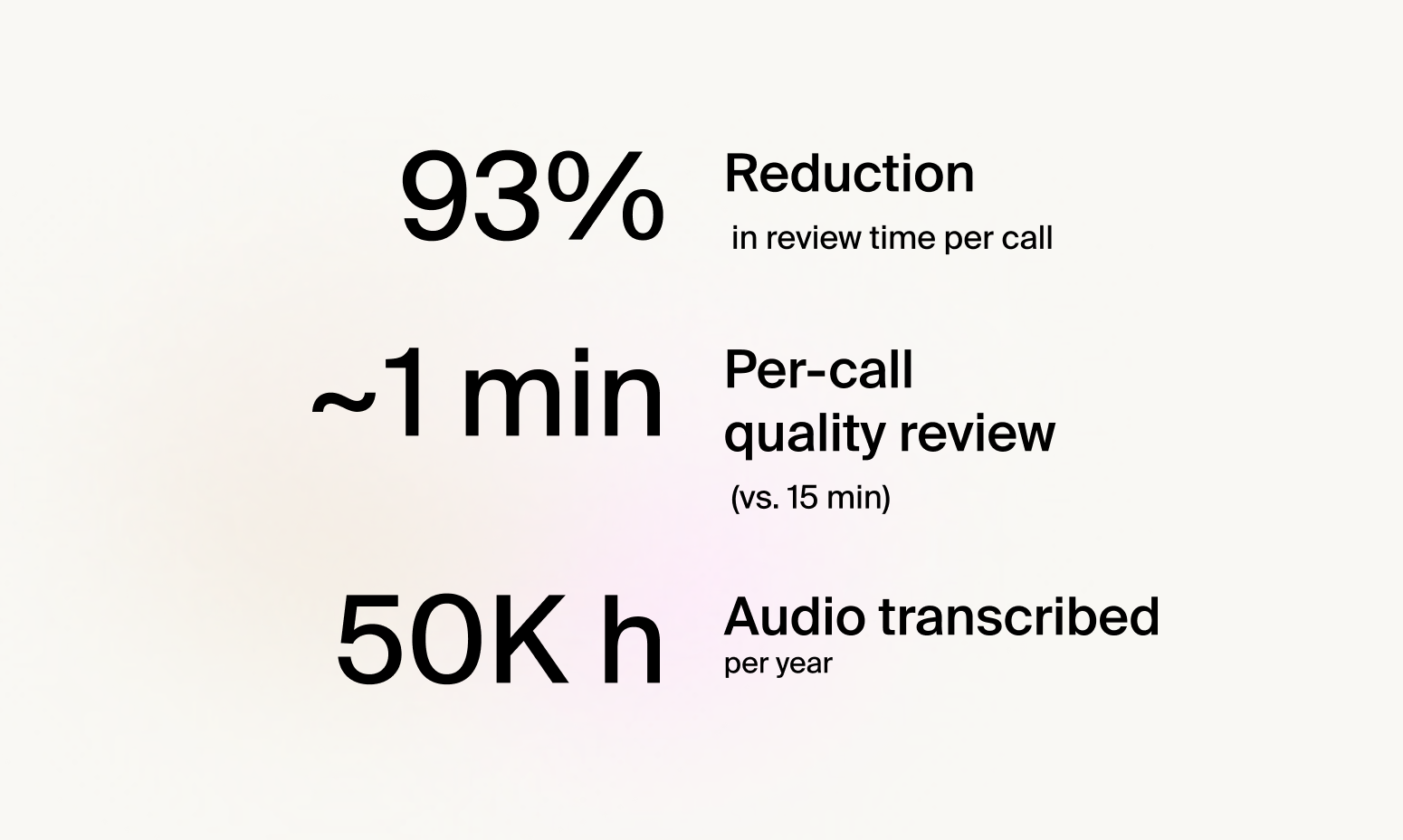
Reliability at scale: With 50,000 hours of audio processed per year across large enterprise clients, reliability and consistent throughput are essential. Gladia has handled Gravite's volume without requiring a fallback or secondary provider.
Results
The most concrete metric from Gravite's deployment is the time saved on individual call reviews. Before automated quality monitoring, a supervisor doing a manual review of an eight-minute call would spend roughly fifteen minutes in total, listening to the recording, evaluating ten or more quality criteria, and documenting results.
With Gravite powered by Gladia, the same review takes approximately one minute. That is a 93% reduction in quality monitoring time per call — a transformation that makes 100% coverage of calls feasible for the first time.
* From sampling to full coverage: Manual picking forced teams to sample a small fraction of calls. The Gravite + Gladia pipeline makes it economically viable to analyze every single call automatically — turning quality monitoring from a reactive spot-check into a continuous, systematic practice.
Additional outcomes:
✓ Eliminated the need for shadow listening and manual scoring sessions
✓ Enabled instant Slack notifications when an agent score drops below threshold
✓ Unlocked data-driven coaching by surfacing which specific criteria are underperforming across agents
✓ Supported multilingual expansion for enterprise clients operating across Europe
Looking ahead
Gravite is deepening its use of Gladia's feature set as the product matures. Several initiatives are being considered:
Custom vocabulary:Gravite is implementing Gladia's custom vocabulary feature to improve brand name recognition in transcripts. The most common quality criterion clients monitor is the agent introduction ("Bonjour, je m'appelle X from Company Y"), and accurate brand transcription is critical to scoring it correctly.
PII Reduction: Gravite handles sensitive customer data on behalf of enterprise clients with strict data protection requirements. Gladia's recently launched PII Reduction feature, which automatically masks personally identifiable information in transcripts, is a natural fit for Gravite's compliance-forward architecture.
Geographic expansion: As Gravite grows into German, Italian, and Spanish-speaking markets, Gladia's multilingual transcription capabilities will be central to that expansion. The partnership is already supporting calls in multiple European languages.
Broader use case coverage: Gravite's flexible workflow engine is beginning to support use cases beyond quality monitoring, including call summarization and agent performance notifications. Each of these relies on the same Gladia transcription foundation.
About Gladia
Gladia provides a speech-to-text and audio intelligence API for building virtual meeting and note-taking apps, call center platforms, and media products — delivering transcription, translation, and insights powered by best-in-class ASR, LLMs, and GenAI models. Gladia is GDPR compliant, HIPAA compliant, SOC 2 Type II certified, and ISO 27001 compliant.
After reading this case study, do you think Gladia could be the right fit for your business? Contact the Gladia sales team to explore this in more detail.
Contact us
Your request has been registered
A problem occurred while submitting the form.
Read more
Speech-To-Text
MiFID II and FCA call recording: compliance for voice transcription in finance
Speech-To-Text
Why speech-to-text accuracy matters upstream of your LLM


.png)