Lorem ipsum dolor sit amet, consectetur adipiscing elit, sed do eiusmod tempor incididunt ut labore et dolore magna aliqua. Ut enim ad minim veniam, quis nostrud exercitation ullamco laboris nisi ut aliquip ex ea commodo consequat. Duis aute irure dolor in reprehenderit in voluptate velit esse cillum dolore eu fugiat nulla pariatur.
MiFID II and FCA call recording: compliance for voice transcription in finance
TL;DR: Financial firms operating under MiFID II and FCA jurisdictions must maintain searchable, high-accuracy records of all client-related voice communications, including remote and mobile calls under FCA Market Watch 66. Engineering and product teams building for these obligations typically implement dedicated cloud infrastructure with defined data residency, controls that prevent customer audio from being used to retrain models on Growth and Enterprise plans, and transcription accurate enough that the resulting records hold up under regulatory review. Transcription and speaker attribution errors are not product quality issues in this context. They are audit trail failures, and regulators treat them as such.
Why speech-to-text accuracy matters upstream of your LLM
TL;DR: Downstream LLM performance is ceiling-bounded by upstream transcription accuracy. A transcript with a meaningful error rate doesn't produce proportionally degraded summaries or CRM entries. It produces outputs where hallucinated names, inverted logic, and misattributed speaker turns compound silently into every downstream system that reads them. Prompt engineering cannot recover information the STT layer never captured. Gravite cut call quality review time by 93%, from 15 minutes to 1 minute per call, once transcript accuracy was high enough to trust the output without manual verification.
TL;DR: Telephony audio is constrained to 8kHz narrowband frequencies, stripping away the high-frequency spectral energy that generic 16kHz STT models require. Standard upsampling cannot recover phonemes that were never captured at the source, leading to transcription errors that compound silently into downstream NLU failures. Solaria-3 ranks #1 on Switchboard, the most challenging conversational telephony dataset, ahead of AssemblyAI, ElevenLabs, Deepgram, Mistral, and Speechmatics, ensuring your downstream LLM pipelines receive clean, structured data from real-world noisy call audio.
How Selectra is automating quality monitoring of sales calls with speech-to-text AI
Published on Sep 9, 2024
In the past few years, the democratization of speech recognition and large language models has created new opportunities for voice-first platforms to automate critical workflows. Customer support is one of the most promising and vibrant areas for these innovations.
Selectra, a leading utility comparison and sales company, operates an extensive in-house fleet of on-call sales representatives and is actively embracing the new paradigm to improve agent productivity and customer experience. The company uses Gladia AI's speech-to-text engine to improve quality monitoring and extract in-depth insights from every call, continuously refining its customer experience. Here comes their story.
About Selectra
Selectra was founded in 2007 in France with the aim of helping consumers choose among the many electricity providers emerging on the market.
Since then, the company pursued rapid growth, reaching more than 200 million unique visitors a year to its websites. Now active in 17 countries, it has expanded across verticals – insurance, telecom, banking and others – and now caters to both individual consumers and companies through educational content and dedicated call center support.
Challenge
The company receives thousands of inbound calls daily from customers who want to learn more about the different providers. During the call, the call agent’s goal is to suggest the best offer for the customer. In France alone, the company has over 200 sales agents processing calls daily.
In this context, quality monitoring is key to consistently improving customer experience. The company’s dedicated quality assurance team is responsible for reviewing the quality of the call based on pre-set criteria.
Historically, the team would process the calls one by one, which involved downloading the call and reviewing each transcript in search of specific words and phrases to ensure compliance with internal protocols.
The process was time-consuming, but with the emergence of Large Language Models (LLMs), Selectra could automate it in part by feeding the call transcripts to the model and letting the latter determine the degree of compliance and extract necessary insights.
This substantially accelerates the work of the human agents, as all they need to do in this case is validate the model’s findings using Selectra’s internal platform, built specifically for the new workflow.
In parallel, the company began to leverage speech-to-text technology to acquire more in-depth insight into customer needs and sentiments and analyze sales reps’ performance in more detail.
Objectives
To make all of the above possible, Selectra looked for a speech-to-text API to provide a solid foundation for the internal quality assurance and analytics platform, combining the following:
Top-quality async transcription, free of hallucinations, to ensure the best possible input for LLMs.
Impeccable accuracy in French, with the prospects of expanding to other languages.
Transcript displayable in sentences (as opposed to utterances), with correct punctuation and named entities
Solution
Enter Gladia! With Gladia, Selectra was able to implement the following product features and improvements:
Enhanced search experience, enabling agents to easily locate a specific segment of a call thanks to error-free capture.
Automated quality monitoring, where transcription is used to record the call and match the output to the original script to assess the degree of compliance, with human agents simply having to validate the final assessment.
Extracting topics and sentiments, to determine how customers feel on the call and identify recurring issues.
Preview of Selectra's internal platform for quality monitoring
Impact
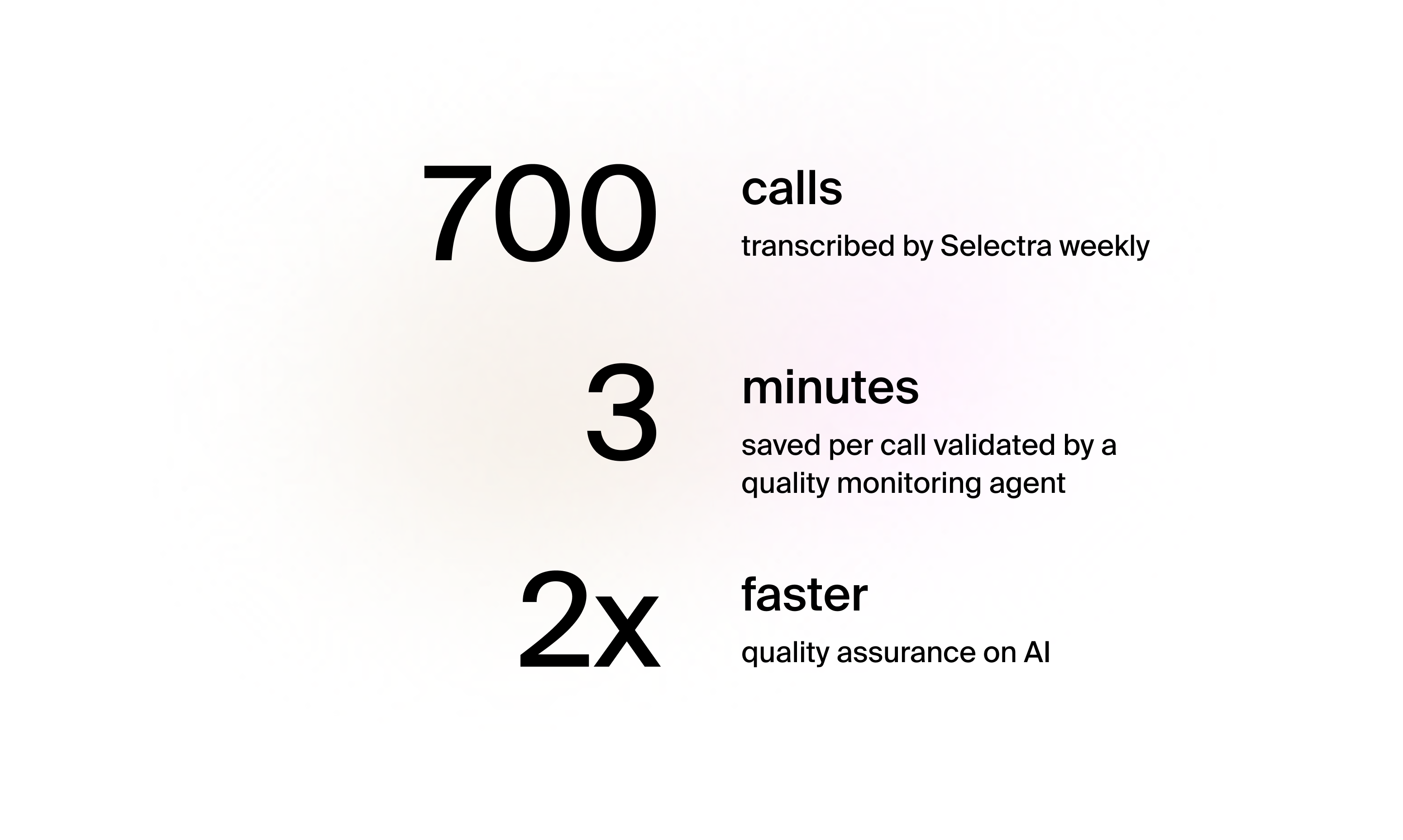
After deciding to add audio transcription to the new quality monitoring project, Selectra started testing the API immediately. By working with the Gladia team to iterate and scale up, they saw a noticeable impact on the efficiency of the quality assurance workflow:
Today, the Selectra team is already considering how they can leverage Gladia’s transcription further with the audio intelligence add-ons (like chapterization, NER and others), as well as our product's real-time capabilities.
As speech recognition and LLMs become more advanced, Selectra is convinced that metadata from calls will be used in multiple new ways moving forward, enabling them to extract truly granular insights from every customer interaction. We thank Selectra for their trust and looking forward to pushing the boundaries of what speech recognition together.
About Gladia
Gladia provides a speech-to-text and audio intelligence API for building virtual meeting and note-taking apps, call center platforms, and media products, providing transcription, translation, and insights powered by best-in-class ASR, LLMs and GenAI models.
Having read this case study, do you feel like Gladia could be the right fit for your business too?



.png)