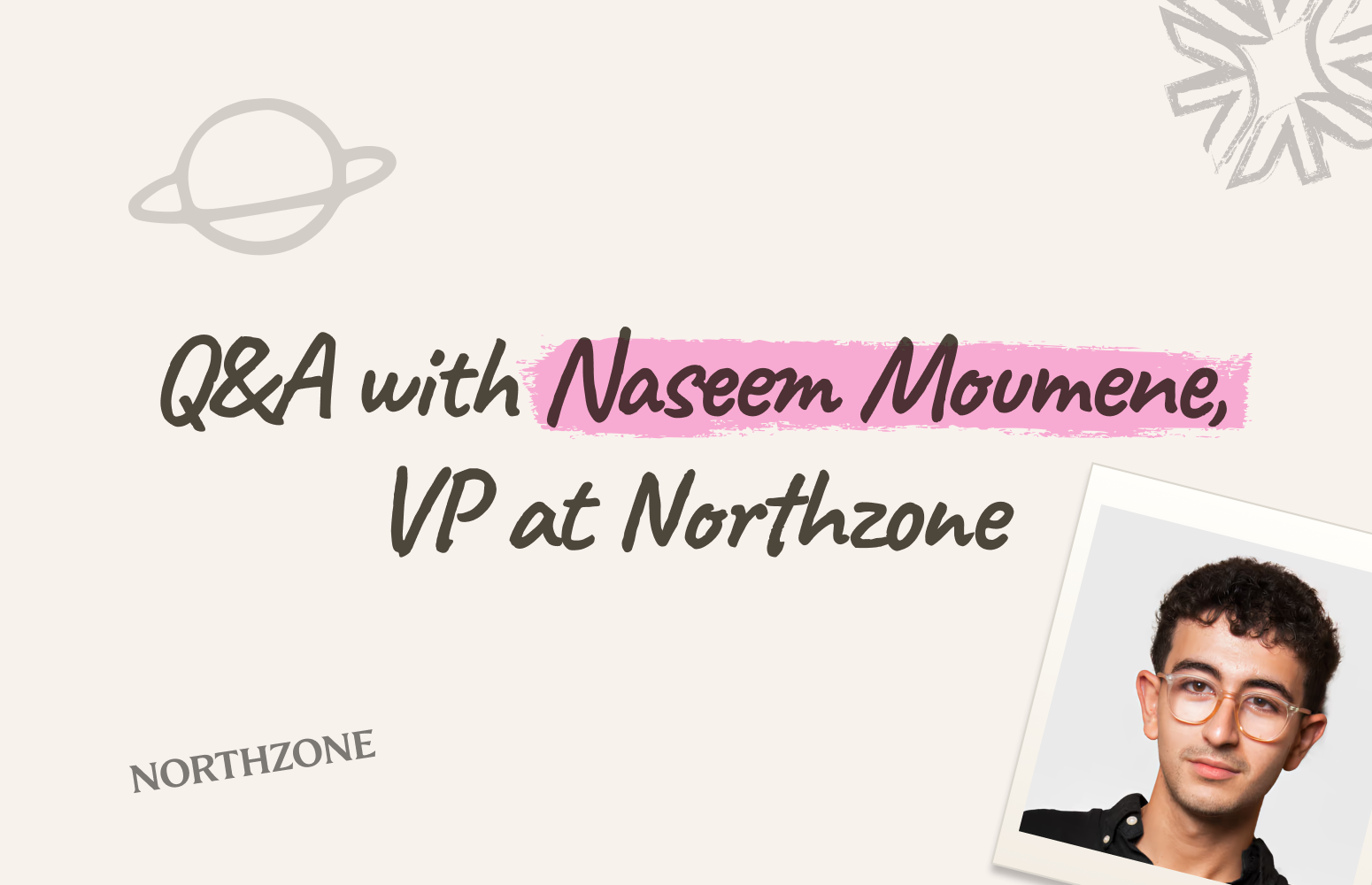
To better understand where it’s headed, we sat down with Naseem Moumene, investor at Northzone, who spends his days evaluating AI productivity companies across Europe and the US.
A few takeaways:
- The strongest players in the category refuse to call themselves meeting assistants. The real business is always the vertical workflow underneath.
- Basics still aren't solved. Cross-meeting search, speaker attribution, consistent identity across sessions — these are table stakes that most tools still miss.
- The proactive, agentic vision everyone is selling is a data problem first. Without accurate, speaker-attributed transcripts underneath, none of it works.
This is a supplement to Gladia's ungated 2026 Meeting Assistant Market Map — now live!
The conversation has been lightly edited for length and clarity.
Q&A with Naseem from Northzone
Gladia: One of the first questions with any AI category is whether it goes horizontal or vertical. How do you see that playing out with meeting assistants?
Naseem: From a thesis perspective, I think the generalizable assistants — a Granola, a Fireflies, those types of meeting note-takers — are the best wedge for general AI assistance in daily work. Or should I say white-collar work. But just like in any other industry, even with foundational models, you end up seeing a bunch of verticalized options come out of that. So you'll have horizontal things trying to capture the general work that's pretty standard at the office, and verticalized stuff that wedges into very specific niche industries.
Gladia: You keep using the word "wedge." Can you unpack that? Because a lot of these companies market themselves as meeting assistants.
Naseem: The horizontal ones do. But the vertical players don't — they're not businesses that say they're meeting assistants. The wedge product is a meeting assistant, but none of those companies would ever call themselves a meeting assistant company. The best example in the UK is probably Saturn. What does it actually say on their website? It's an operating system for financial infrastructure. But underneath, it's a meeting assistant.
Saturn captures the most context in the most important part of a financial advisor's journey. And instead of going wide like Granola, they go deep — tooling, integrations, financial instruments, whatever the workflow needs. So, you're not a meeting notes business anymore. You're a financial business.
Gladia: So why can't a horizontal player just extend into a vertical? Granola has the capture, the transcription, the summarization. In theory, they could ship a compliance template and be in wealth management tomorrow.
Naseem: In theory, sure. In practice, no. For finance specifically it's super different to a general meeting assistance company like Granola or Fyxer. And I don't think a Granola or a Fireflies today could work in a financial setting — just because the perception, the brand, the compliance requirements, all of that is so different. The outputs needed are so specific. They could physically do it if they built the right product around it. But I don't think they would.
Gladia: Let's talk about the horizontal layer then. Do you think the market is evolving as fast as the headlines make it sound?
Naseem: Honestly, no. I would have imagined day-to-day life wouldn't be as fragmented as it is today. I would have thought consolidation would happen quicker. But it's still relatively all to play for.
And I don't think it's evolving that fast, because you should be able to see people taking notes differently by now, storing their databases differently, keeping their most important information elsewhere, using this stuff a lot more. For example, today I should be able to just search: what is everything I've ever said to any fintech company about this topic? But I can't, and that doesn't make any sense to me. Same way — if me and a colleague of mine had met 30 companies this month, I should be able to say, what has my colleague ever said about X company or Y company? But oftentimes, it doesn't even know who's speaking! These are basic things that I think should have been done.
Gladia: Right, speaker attribution is still genuinely unreliable across a lot of tools. What about the big platforms — Google, Microsoft? Their note-taking features good enough to credibly threaten the independents?
Naseem: Not yet. Which is strange, because Google has everything they need: Drive, Gmail, the models, the distribution. On paper it should be a layup for them. But the actual product experience of their native notes is poor today.
That said, I wouldn't underestimate Google. Clearly, at least now with Gemini and the rest, they're doing a fantastic job. So it might just be that they're going after other things first.
Gladia: What do you think is the biggest problem these tools are trying to solve long-term?
Naseem: Corporate memory loss, business memory — it's always been an issue, and people have gone after it in many ways. RPA. Rules-based processing. Then machine learning. Then the whole wave of agentic stuff trying to capture context. People have been trying to solve this corporate memory loss problem in a lot of different ways for a long time.
I think meeting notes did it accidentally, or are doing it accidentally, very quickly. But they still can't solve it yet. The capture is fine. The recall is broken.
Gladia: If you zoom out and think about what separates the eventual winners from the ones that fade — what's the model?
Naseem: I think about this exactly the same way as consumer social. Typically, with a consumer social app, you start off by building the best core behavioral loop – whatever works to drive engagement and keep people using the product every day. For Tinder, that's swiping. For Instagram, scrolling. For Snapchat, photo and message. They do one thing, and then, within a short period of time, they release a bunch of features on top of that to extend the core behavioral loop. That's how you build out an Instagram that has stories, a Snapchat that has lenses, with both making billions a year.
But sometimes even people who capture that core behavioral loop don't build enough features, (or the right ones) to secure a strong long-term user base. The best example is BeReal. BeReal had an amazing behavioral loop. Zero to 40-50 million monthly active users. Everyone loved it. But it took them two years to build a new feature and it died.
So the way I see the meeting assistant thing is exactly the same. It's very much consumer, even when people pretend it's business. Many of them have captured that core behavioral loop — join a meeting, get notes, retain users. But now it's becoming a question of who's going to build out the rest of the features. And that's still all to play for.
Gladia: Talk to us about your own workflow. How has your usage of these tools actually changed over the past year?
Naseem: It's changed a lot, and in ways I don't think the product teams are necessarily optimizing for yet.
I used to use Granola, and then copy that into Notion, which is where we collaborate as a team at Northzone.. And now I catch myself doing two weird things. One, I forget to put anything in Notion And two, I'm no longer really using Granola either. I mean, I leave it on. But I just pull from it when I need, via Claude. If Claude is connected to my Granola, I don't need to copy and paste a bunch of stuff into there. I just say: "hey, I'm working on this, I think I've had a couple of meetings on it, can you look into my Granola and pull up whatever you need?"
It's still a test of where people spend most of their time. If the behavior shifts to an AI assistant pulling meeting context on demand, then the meeting assistant itself becomes more of a data layer than a destination. That is a very different business.
Gladia: So what would a great meeting assistant look like two years from now? What's the unlock?
Naseem: The most interesting company would surface information when you need it. Actually, when you don't even know that you need it. Like, we're speaking here, and I say "consumer social," and it pulls a note from someone that spoke about consumer social ages ago and said, "oh, this is what this company did, and you spoke about it seven months ago." That's what I think would be amazing. We're not there yet. It needs to proactively surface things. Today it's very, very reactive.
And the infrastructure underneath has to be there for that to work. If the transcripts are wrong, if the speakers are mislabeled, if search across meetings doesn't work — everything you try to build on top inherits those errors. That's why I keep coming back to the basics, still not being solved. Until they are, the agentic, proactive version of this is going to keep feeling a year away.
Keep exploring the 2026 AI work assistant market map
Naseem's perspective is one of several that shaped the map. If this conversation was useful, the full 2026 Meeting Assistant Market Map goes much deeper (and it's completely ungated).
Inside, you'll find:
- A full breakdown of ~70 companies across the horizontal, vertical, and infrastructure layers of the category
- Where the category is heading: consolidation scenarios, platform risk from Google and Microsoft, and what independents need to do to stay ahead
- Deep dives on the verticals that matter most: finance, sales, legal, healthcare — and why the winners there look nothing like horizontal note-takers
- The infrastructure story underneath: what's actually holding the ambitious product visions back, and what needs to be true for the next wave to ship
- More Q&As with founders and investors building and backing this space