→ Read the full report
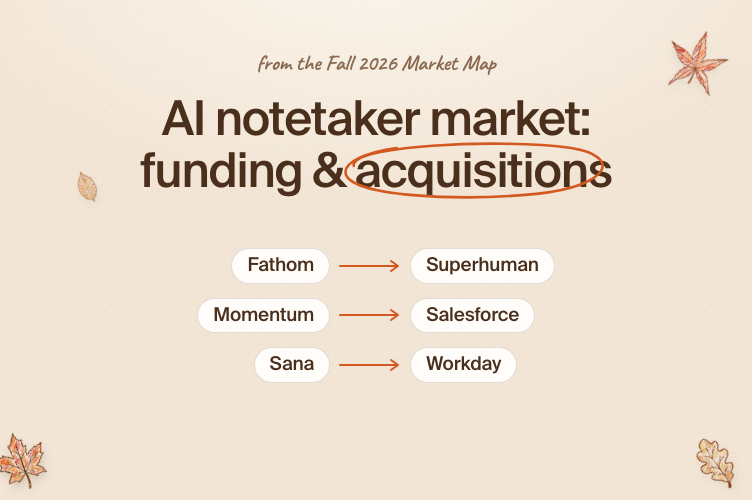
But products and users only tell part of the story. If you really want to know where a market is going, follow the money. In 2026 alone, vendors on our map raised more than $750 million, four were acquired outright, and two passed billion-dollar valuations.
So, what do these announcements (and others) actually tell us about the market today, and where it's heading next?
1. Platforms are buying what they couldn’t build
The biggest buyers this year all had something in common. Each already owned a workflow or a system of record. What they didn't own was the conversation feeding it.
Salesforce closed its acquisition of Momentum in March, so conversation data from Zoom and Google Meet can feed its AI agents. In June, Aircall bought Piper, which turns calls, emails and WhatsApp messages into CRM updates. And in September, Superhuman bought Fathom to give its proactive assistant, Superhuman Go, the context it was missing.
None of this came out of nowhere. Late in 2025, Workday completed its ~$1.1B acquisition of Sana and Lemlist bought Claap.
But why are platforms so eager to own the conversation? And why buy instead of build?
Superhuman answered the second question for us. It tested its own notetaker internally before deciding to acquire Fathom, and CEO Shishir Mehrotra admitted that it’s “actually quite tricky to do a great job in all parts” of meeting recording.
We could have told you that…
Ultimately, though, what these buyers want is context. Every one of them is building AI agents, and an agent is only as useful as what it knows. Conversations are where decisions, objections, and next steps actually happen.
2. Investors are funding the jump from notetaker to assistant
Big platforms weren’t the only ones spending. Newcomers and veterans alike raised record rounds, and they have the growth to back it up.
Of course there’s the category’s darling, Granola. Its bot-free notes app won a loyal following among founders and investors, and in March that loyalty turned into a $125M Series C at a $1.5B valuation, a roughly sixfold jump in under a year. Alongside the round, it launched team workspaces, chat, and public APIs, and began pitching itself as an enterprise context layer rather than a notes app.
We saw something similar play out with Wispr Flow. It built its name on dictation, then raised $280M at a $2B valuation in August, then introduced Canto, its own speech model. It’s now bringing meetings into the product.
Then there’s Otter. It launched nearly a decade ago as a transcription tool, long before “AI notetaker” was a category. In October, it announced $320M from General Catalyst’s Customer Value Fund. This is non-dilutive growth capital earmarked for enterprise growth, go-to-market, international expansion, and product.
Each company had a different starting point. All three raised big for the same reason: conversations are the input for the future of work.
3. Money is moving into workflows and verticals
Not all of this year's money went to horizontal notetakers. A lot of it went to companies that use conversations to run a specific job end to end.
Metaview, which started as an interview notetaker, acquired AI recruiting startup Reval in August to accelerate fillmore, an AI coworker that sources candidates, handles outreach and books screening calls on its own. Attention raised a $30M Series B in June on a simple pitch: it runs revenue teams instead of just recording them. Its ARR grew 4x year over year.
The most telling round may be Auctor's $20M, led by Sequoia. Auctor embeds meeting capture into software implementation projects. Alongside Sequoia, the venture arms of Microsoft, HubSpot and Workday all invested. Platforms aren't only buying conversation capture. They're investing in it, too.
4. Some of the fastest growth came without major funding
Following the money also means noticing where it isn't. Some of the year's most impressive growth came from companies that barely raised at all.
Plaud says its software ARR grew from $1M to $100M in two years, with more than 2 million users. It got there on founder savings, a crowdfunding campaign and only around $5M from outside investors, and it’s profitable. Its model is simple: sell the device, then sell the software that makes it useful.
Pocket, while also a hardwares solution, is taking a different approach. The Y Combinator Winter 2026 company sells a recorder with no subscription. According to its own launch figures, it delivered 30,000+ units in five months and reached a $27M annualized revenue run rate. Same trend, opposite model: one bets on recurring software revenue, the other on removing it.
Software players are building without big rounds, too.
Fireflies hit a $1B valuation through a tender offer without raising new capital since 2021, and says it still hasn’t touched its Series A money. Belgium’s Leexi is bootstrapped and profitable, and signed a national distribution deal with Proximus, the country’s largest telco. And Gong, which hasn’t raised since its $250M Series E in June 2021, saw ARR pass $500M this year.
What we expect in the next 6–12 months
While we don’t know for sure, here’s what we’re betting our money on:
- At least two more notetakers will be acquired. The likeliest targets share a profile: large product-led user bases, a recognizable brand, solid capture technology, and no clear path into the enterprise on their own. The likeliest buyers own a workflow but not the conversation behind it: project management, email and calendar, HR, and customer support platforms.
- The next breakout tools will be built around a specific job rather than a specific person or team. The horizontal space is crowded, and tools like Auctor show a different path to success. We expect more tools will be organized around a case or a project, versus being built for specific teams or users.
- The next wave of repositioning will be about collaboration. We’re talking about shared knowledge across teams, assistants that join the conversation live, and systems that connect what was said across hundreds of meetings. All of this means more seats per customer, more data per account, and stickier products. That’s exactly what investors are looking for.
We'll revisit these predictions in a few months and see how we did. In the meantime, check out the latest market map here.