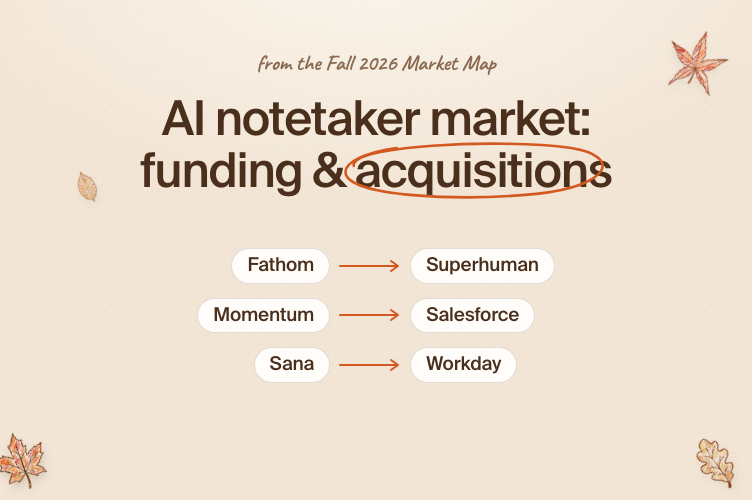
To better understand this market, we mapped it, asking 2,100 users across 6 countries how they’re using these tools today, and evaluating over 100 vendors to see how products are differentiating. But the current state of the market only tells us half the story. That’s why we also traced its evolution.
Here’s what we found out.
Three origin stories shape today’s meeting assistants
Looking at the key players, there are three primary product origin stories for this market.
Origin 01: Tools built from day one as AI-native meeting assistants
These are the products people are most likely to think of within this category: Fireflies.ai, Fathom, Granola, Fellow. Naseem Moumene, VP at Northzone, says in our Q&A with him that most of them have captured the core behavioral loop: join a meeting, get notes, and retain users. What comes after that loop is still open.
Advantages
- Built for one thing: Every product decision optimizes for the meeting experience, nothing else.
- Moves fast: No legacy architecture or internal politics slowing things down.
- Easy to love: Narrow focus tends to produce sharper, more intuitive UX.
Constraints
- Starting from zero: Every integration and enterprise relationship has to be earned from scratch.
- Distribution is hard: No existing user base to grow from; every user has to be acquired.
- Growth requires expansion: To scale, the product eventually has to become more than a meeting tool.
Origin 02: Evolved from somewhere adjacent
These companies first solved a neighboring problem, like transcription, sales coaching, or meeting analytics, then grew into meeting assistants from there: Otter.ai, Gong, Read AI.
Otter.ai was founded in 2016 as a transcription tool and launched OtterPilot, an assistant that joins calls and writes summaries, in 2023. Gong, on the other hand, launched in 2015 to record and replay sales calls for coaching, and grew into a system of record for sales conversations as more selling moved onto video during COVID. Read AI launched with dashboards that measured how engaged people were in video meetings, then added AI summaries on top.
The reason is the same each time: once a product is already in the meeting and already has the transcript, generative AI makes summaries and follow-ups a short step away.
Advantages
- Strong foundations: Deep technical expertise in at least one hard problem already solved.
- Existing trust: An established user base that already believes in the product.
- Adjacent leverage: Prior integrations and workflows give them a head start on the stack.
Constraints
- Legacy baggage: The original product can be a ceiling as much as a foundation.
- Identity problem: Convincing users (and the market) to see them differently is slow, hard work.
- Split focus: Roadmap priorities are always competing with the core product.
Origin 03: Platform players with meeting assistance as a feature inside a much larger product
For most people, the meeting assistant they know best is the one built into the tools they already use every day: Microsoft, Google, Zoom. It makes sense that these platforms would add meeting assistance on top of the calls they already host, and their brand awareness gives them a head start no newer tool can match.
Our survey shows just how big that head start is: more than half of respondents used Teams, but only 1 in 7 had even heard of specialized new entrants like Granola and Fathom.
Advantages
- Default distribution: Access to millions of users who already live inside their ecosystem.
- Already embedded: Deep hooks into the tools and workflows people use every day.
- Enterprise trust: Compliance, security, and procurement relationships already in place.
Constraints
- Features, not products: Meeting assistance competes internally with dozens of other priorities.
- Slow to move: Innovation at platform scale is measured in quarters, not weeks.
- Good enough is the enemy: “Included in your subscription” sets a low bar that’s hard to push past.
To be clear: none of these starting points are inherently better than the other and, regardless of where they started, they’re all navigating a similar evolutionary arc.
Next stop: agentic workplace assistants
Based on our research and conversations with investors, this market, like many others, is racing toward an agentic future. In that future, the AI assistant understands context, takes initiative, and works like a colleague, instead of just recording what was said.
Today, most products are still much closer to the transcription end than the agentic end. So how does a meeting assistant actually get from one to the other? It has to solve a series of challenges, and every one of them depends on getting the first one right.
Challenge 1: capture
The first wave solved a simple problem: stop making humans do the work of recording what happened in a meeting. Reactive and isolated, these tools capture, summarize, and deliver. Many products are still essentially here.
Challenge 1 is also where most usage lives: 71% of the users we surveyed rely on their assistant for meeting summaries. It looks simple from the user’s side. On the infrastructure side, though, Zoom, Google Meet, and Microsoft Teams each expose different APIs, and some expose none at all. Getting real speaker names instead of “speaker 1” and “speaker 2” is one of the hardest edge cases in capture, according to Recall.ai.
Key tech challenges:
Challenge 2: connect
The conversation stops being an isolated output and becomes an operational input. CRM fields get updated, tasks assigned, follow-up emails drafted. The AI proposes, the human approves. Most workflow execution stays supervised.
This is the step most users haven’t taken yet. It’s also where the engineering gets harder.
Key tech challenges:
From here, the challenges get even harder to solve. Capture and integration are mostly engineering problems with known answers. What comes next asks the product to connect what multiple people say and know, then remember across months and even years of conversations, and finally act on its own while the meeting is still happening.
Challenge 3: connected memory
Conversations don’t just get processed and filed, they get connected. A question today surfaces context from six months ago. A decision in one team becomes visible to another. Over time, it stops feeling like a tool and starts feeling like institutional memory.
This is the territory of what our map calls Knowledge Graphs: tools that win through accumulation, synthesizing across conversations, documents, and systems over time. It’s the most ambitious position on the map and the hardest to build. Accumulated context is also what creates real lock-in: products that treat each meeting as an isolated event stay easy to replace.
To see which products sit here today, check the Knowledge Graphs quadrant in the latest market map.
Key tech challenges:
- Scalable transcript + embedding storage
- Vector search + RAG (retrieval-augmented generation) over transcripts
- Cross-meeting speaker identification
Challenge 4: live action
The agent is live on the call with you. It listens in real-time, detects a risk or an opportunity, and surfaces the right context, proactively. After the call, it doesn’t wait for instructions; it acts. No manual input. No handoff. Just execution, on the org’s behalf.
This is where the market is starting to move. Products are beginning to nail live functionality: Otter launched live in-call coaching, and Fireflies added voice agents alongside a wave of other launches, as meeting assistants move from summarizing a conversation after it ends to helping while it’s still happening. The early versions of this are what our map calls Live Coaches: tools built to surface intelligence during the conversation. And to work at the moment, they have to keep latency under 200 ms across their entire stack.
For the current lineup, head to the Live Coaches quadrant in our latest market map.
Key tech challenges:
Final destination: the ultimate agentic workplace platform
The destination is a collaborative, autonomous tool people can’t imagine working without. One that’s embedded in how teams think, decide, and act.
Collaboration is a big part of how a product gets there. As Julien Bek, Partner at Sequoia, told us: “For these meeting assistant companies to become really big, they need to crack collaboration. That’s the next stage where they can really become systems of work.”
Each challenge explored above solves a different part of the same puzzle, because a true AI workplace assistant requires all four. Memory without action is a better filing system. Action without memory is a faster bot.
The products that figure out how to combine them are the ones that will define this category.
This market moves fast, and we update the report regularly as vendors ship new features and change strategy. To see where the leading meeting assistants sit today across capture, intelligence, integrations, and market strategy, explore the latest market map.
And if you’re building a meeting assistant, test Gladia’s transcription on your own meeting audio in the playground. New accounts start with 50€ of free credit. Enjoy!