But the bar is higher for these tools.
Vertical players face deeper technical challenges, stricter compliance requirements, and a more demanding buyer. For them, accurate domain language isn't a nice-to-have. It's the entire value proposition.
Below, we look at four verticals: sales, recruitment, healthcare, and financial advice. For each one, we cover what users expect that a generic notetaker can't deliver, and how the best products meet those expectations.
Technical requirements for AI notetakers by industry
Every vertical needs the same building blocks. The table shows how critical each one is, and the sections below explain why.
| Requirement |
Sales |
Recruitment |
Healthcare |
Financial advice |
| Real-time latency |
High (critical for live guidance) |
Moderate (critical for AI interviewers) |
Moderate, rising |
Low |
| Domain vocabulary |
High (company, product and competitor names) |
High (skills, technical jargon) |
Critical (drugs, dosages, specialty terms) |
Critical (figures, products, names) |
| Speaker separation |
Critical (rep vs prospect) |
Critical (candidate vs interviewer) |
Critical (clinician, patient, family) |
Critical (households, multiple clients) |
| Compliance and data retention |
High (Europe, regulated sales) |
Critical (EU AI Act, consent, bias audits) |
Critical (HIPAA, GDPR, consent) |
Critical (books and records, Consumer Duty) |
| Difficult audio |
High (telephony) |
Moderate (mostly video, some phone screens) |
Critical (in-room, far-field) |
High (in-person, phone, video) |
| Structured output and writeback |
Critical (CRM fields) |
Critical (ATS scorecards) |
Critical (EHR, coding) |
Critical (suitability reports, file notes) |
| Multilingual and accents |
High in Europe (code-switching) |
High (accent fairness) |
High (patient populations) |
Moderate (accent robustness high in UK) |
Sales and revenue
Sales is the most established vertical in this market. Gong alone counts more than 5,000 customer organizations, and newer players like Attention, Claap (acq. lemlist), Jiminny and Praiz have built strong businesses around specific parts of the sales workflow.
What sets them apart from a generic notetaker is what happens after the call. A recap is useful, but sales teams need updated pipeline fields, coaching data, and follow-ups that move deals forward.
Here’s what they have to do well:
Keep the CRM accurate without anyone typing
Reps dislike data entry, and pipeline reports suffer for it. That’s why tools in this category promise to fill the CRM straight from the conversation.
Attention updates required fields in one click, Claap writes typed values into mapped HubSpot and Salesforce fields, and Praiz builds its pitch on the premise that CRM data is unreliable.
The hard part is that extraction errors fail silently. A note logged against the wrong opportunity, or a misheard competitor name, doesn't throw an error. It sits in the pipeline until someone notices the forecast is off. That makes accuracy on named entities (companies, products, competitors, figures) more important than headline word error rate, because those are exactly the words that end up in fields.
Know exactly who said what
Talk ratios, objection tracking and rep scoring all depend on telling the rep apart from the prospect. When diarization gets it wrong, a prospect's objection is attributed to the rep, the coaching score is inverted and the deal notes say the opposite of what happened.
The problem gets harder as deals mature. Late-stage calls bring in procurement, legal and several stakeholders, and diarization errors rise with every extra speaker. Those are also the calls where accurate attribution matters most.
Guide reps in the moment
Some sales tools work during the call, not after it. For example, Attention surfaces live battlecards and talk tracks drawn from the team's playbook, so reps can answer a competitor question without switching tabs.
The technical bar is unforgiving: a suggestion that arrives after the moment has passed is useless. Live guidance needs streaming transcription with very low latency across the whole stack, which our report puts at under 200 ms.
Capture calls wherever they happen
Most sales conversations now happen on video, but phone still matters for inbound teams, SMB sales and regulated industries. Leexi captures Ringover and Aircall calls alongside video meetings and in-person conversations through its mobile app, and Jiminny is built around dialer integrations.
But phone audio is where accuracy breaks.
Standard telephony squeezes speech into a narrow frequency band, stripping out much of the detail speech models rely on. Gladia's open speech-to-text benchmark shows the size of the gap. On real customer meeting audio, leading providers score word error rates of roughly 10–13%. On Switchboard, a standard dataset of recorded phone conversations, the same providers range from 34% to 55%, with Gladia's Solaria-3 ranking #1 with the lowest at 34%.
The bottom line: products that handle phone calls need speech recognition that's proven on real phone audio, not just clean meeting recordings.
Work across languages and borders
Many of the most interesting sales tools are European, and their customers rarely run every call in one language. Jiminny recently shipped transcription that handles multiple languages within a single call, a growing requirement for teams selling across markets.
But selling across borders doesn't just mean more languages. It means more data rules, too.
For European buyers, where call data is stored is a buying criterion, so vendors lead with EU or in-country hosting and security certifications like ISO 27001. The same caution extends to recording itself, with tools adding controls that let teams exclude customers who don't want to be recorded.
We dig into this in the Capture moat of our market map, which looks at who's in control of what gets recorded: the organization or the individual user.
Recruitment
Recruitment tools are built around one simple job: letting interviewers listen instead of type.
Metaview serves more than 5,000 companies, BrightHire counts 450+ organizations including Canva, HubSpot and Duolingo, and Noota has a strong following among recruitment agencies, particularly in France. What these products produce isn't a meeting summary. It's an evaluation: evidence mapped to a rubric, written into the applicant tracking system (ATS), and shared with a hiring team that wasn't in the room.
Here’s what they have to do well:
Turn every interview into a completed scorecard
Hiring teams evaluate candidates against a structured rubric that changes by role and stage. Generic tools don't know that rubric, so their output still needs cleaning up before anyone can use it. Recruitment tools map answers to competencies and write the result straight into the candidate record.
Noota writes the report, scorecard and key fields into the ATS and connects to 16 of them, from Bullhorn to Teamtailor.
This means integration reliability is where products win or lose, and it’s not a surprise that sync problems are among the most common complaints in reviews of the leading interview tools.
Back every judgment with evidence
A hiring decision based on a summary is only as good as that summary. That's why recruitment tools put evidence front and center. Metaview's notes, for example, include evidence quotes and a link back to the recording, so scorecards rest on what the candidate actually said rather than the interviewer's memory.
A good product also separates signal from noise. Small talk at the start of an interview isn't candidate evidence, but a generic summarizer can't tell the difference.
Vocabulary matters, too. Engineering interviews are full of technical jargon, and a misheard framework or programming language can change how a candidate's experience reads.
Treat every candidate's voice fairly
In hiring, accents and dialects aren't just an accuracy issue. They're a fairness issue. A Stanford study found leading speech recognition systems made almost twice as many errors for Black speakers as for white speakers. Accuracy varies by language too: in Gladia's open benchmark, the same model can make more than twice as many errors in one European language as in another.
The best recruitment tools treat this as a product requirement. They let candidates interview in their own language, and many leave the final score to the interviewer rather than the AI, so a misheard answer doesn't automatically count against a candidate.
For builders, the job is to measure accuracy across the accents and languages a customer actually hires in, and to check whether any gaps carry through to summaries and scores.
Build consent and compliance in
Candidates need to know they're being recorded, and some will say no.
Recruitment tools can (and should) handle this in the workflow itself: consent notices go out with the interview invite, a candidate can opt out and the interview still runs without recording, and recordings are only visible to the hiring team.
Likewise, retention settings exist to delete interview data automatically after a set period, which matters under GDPR. Some vendors also commission independent bias audits, so customers can show their tools have been tested.
Regulation is tightening too. The EU AI Act classifies AI used in recruitment as high-risk, and following the Digital Omnibus, those obligations now apply from December 2027 rather than August 2026. How much of that applies depends on what the tool does.
A tool that records an interview and writes up what was said is one thing. A tool that scores or ranks candidates is exactly what the high-risk rules target. That's why some recruitment tools offer AI scoring as an optional, clearly labeled feature that a person reviews.
Run the screening conversation itself
The newest recruitment products don't just listen to interviews. They conduct them. BrightHire Screen, for example, runs structured, two-way screening interviews at scale, and Metaview's Screening agent holds adaptive voice conversations with candidates in 18 languages.
That changes the technical requirements completely. Once the product is speaking, latency and turn-taking go from irrelevant to critical. Fraud is emerging as a related concern, with tools starting to flag candidates who may not be who they claim, across both AI screening and live interviews.
Healthcare and clinical documentation
Ambient scribes are among the fastest-adopted technologies in modern medicine, and the most scrutinized. Microsoft's Dragon Copilot reports more than 100,000 clinicians, and Abridge has won enterprise deals from UPMC to the US Department of Veterans Affairs. Nabla and Freed have brought ambient documentation to practices without an IT team, and allied health is following, with physiotherapy-specific tools like FysioScout in Denmark. The output isn't a set of meeting notes. It's a clinical record that a clinician signs and that health systems, insurers and regulators rely on.
Here’s what they have to do well:
Make every line verifiable
Clinicians sign every AI-drafted note, so review is the safety net. The question is whether review actually happens. In a 2026 UC Davis study of AI-generated clinic notes, accidental omissions were the most common error, followed by hallucinations, and 15% of notes went out with no edits at all. Most errors were minor, but a small number carried a risk of serious harm.
The best products design for fast, trustworthy review. Abridge's Linked Evidence lets clinicians highlight any part of a note and jump to the transcript passage and audio it came from, so they can check a detail without replaying the whole visit. Some tools now draft the note during the visit, so clinicians can correct it before the patient leaves.
Get the clinical details exactly right
In a clinical note, one wrong word can matter more than a hundred right ones. A drug name, a dosage or a negation ("no chest pain") has to be exact. That's why headline WER is a weak guide. A June 2026 preprint found that adding background noise to clinical conversations raised WER by less than one percentage point but nearly doubled the rate of unsafe outputs.
Specialty vocabulary adds another layer. Tools that perform well in primary care often need more correction in specialties with less common terms, medications and abbreviations. Builders need to evaluate on the words that carry clinical risk, not just overall accuracy.
Hear clearly in the exam room
Clinical audio rarely comes from a clean video call. It's captured by a phone or device in an exam room, with the clinician moving around, equipment running and family members joining in. For example, Abridge captures in-person, telehealth and chat encounters, and Microsoft has extended Dragon Copilot's ambient capture to nurses and radiologists, each with its own acoustic conditions.
But noise is a big problem, with multiple reviews of small-practice tools mentioning accuracy dropping in noisy rooms.
Multiple voices create a second problem. If a parent says their child has been dizzy all week, the note needs to record that as the parent's report, not the clinician's finding. That's why ambient scribes depend on speech models trained on noisy, far-field audio, and on speaker separation that tells clinician, patient and family apart.
Protect patient data by design
Healthcare buyers expect HIPAA compliance in the US and GDPR compliance in Europe as a baseline. But meeting those rules still leaves builders with big design choices, and one of the biggest is whether to keep the recording at all.
Some scribes process audio in small chunks and discard it, so the full recording is never stored. Others keep the audio so every line of a note can be traced back to what was said. Both are answers to the same question of trust. One minimizes what could leak, and the other maximizes what can be checked.
Consent is unsettled too. In the US, there's no federal standard requiring patient consent for AI scribes, so each facility decides for itself. Vendors are filling the gap with ready-made consent scripts and patient notices clinicians can use before a visit, plus simple ways to skip recording when a patient says no.
Fit the record and feed what comes after
A note is only useful once it's in the electronic health record (EHR). At the enterprise end, integration depth decides deals: Abridge works inside Epic from recording to the patient chart. At the small-practice end, many clinicians still copy notes into the EHR by hand, though direct EHR push is starting to appear. Either way, clinicians expect the note to read like their own, so templates and style matching matter as much as the integration.
Notes are also becoming the input to what comes next: Abridge has launched real-time prior authorization at the point of conversation, and FysioScout is adding automatic ICPC-2 coding for physiotherapists. That raises the accuracy bar again, because the note now feeds billing and payer decisions. It also means real-time matters more in healthcare than it used to.
Financial advice and wealth management
Financial advice is the newest of the four verticals, and it's maturing fast. In fact, G2 created a dedicated AI Assistants for Financial Services category this year.
Popular names include Jump in the US, and Saturn and Aveni in the UK. What advisors need isn't a recap. It's the regulatory paperwork and client documentation that every advice meeting generates.
Here’s what they have to do well:
Produce records that stand up to regulators
Advice conversations carry regulatory obligations, but how AI notes fit into them isn't settled.
In the US, the SEC and FINRA haven't issued clear guidance on AI notetakers, and many firms treat AI summaries as working drafts. Others take a stricter view. Law firm Cooley argues that an advisor using an AI notetaker is generating records under the books and records rule whether it realizes it or not, and those records generally have to be kept for five years. In the UK, the bar is evidencing good client outcomes under the FCA's Consumer Duty.
The safe approach is to design for the stricter reading: audit logs, integrations with archiving systems and a clear review step before anything becomes final. It also means deciding what to keep.
Some advisor tools never store a recording at all. They listen and transcribe as the meeting happens, generate the notes, then discard the audio, on the basis that clients often don't want private conversations recorded and that stored recordings create legal risk. Others keep the recording, so every note can be checked against the source. As in healthcare, neither answer is wrong, but it has to be a deliberate product decision.
Draft the documents advice runs on
For advisors, the meeting itself isn’t what eats up the most time. It’s the paperwork afterwards.
Suitability reports, file notes, fact-finds and client follow-ups all draw on what was said in the room, but turning a conversation into those documents is much harder than summarizing it. The tool has to pull specific facts out of a free-flowing discussion (income, goals, attitude to risk, existing pensions) and map each one to the right field in a structured template. It also has to combine them with what's already on file, because a suitability report draws on the client's records as well as the meeting.
The reasoning matters, too: In the UK, suitability reports must meet FCA requirements on the client's circumstances and the reasons for each recommendation, so the tool needs to capture why the advisor recommended something, not just what was said. When something required wasn't discussed, a good tool flags the gap rather than filling it in. Two-way sync with the advisor's CRM is also essential.
Writing back means updating individual fields like a new address, a changed goal or a fresh risk score, on the right client or household record, in CRMs like Wealthbox, Redtail and Salesforce that each structure data differently. It also means not overwriting details an advisor has already corrected by hand.
Reading works the other way. By pulling what's already on file before the meeting, the tool can spot what has changed and prepare the advisor for the conversation.
Get every number and name right
Advice runs on figures like portfolio values, contribution amounts, fees, percentages and dates…but spoken numbers are surprisingly ambiguous. "Fifteen" and "fifty" sound alike on a poor line, and "two fifty" could mean £250, £2.50 or £250,000 depending on context.
The tool has to hear the number correctly, then turn it into the right written format, using the rest of the conversation to work out the unit. advisors notice when this goes wrong: one round-up of advisor tools flags having to correct financial terms, client names and numbers as the main weakness of an otherwise popular product.
Names are the other weak spot: Client names and fund or product names rarely appear in general training data, so tools use custom vocabularies, often pulled from the CRM, to steer recognition toward the right spelling.
Accents matter here too, particularly in the UK, where accurate recognition across regional and Irish accents is a selling point in its own right.
Keep each client's information with the right client
Advice meetings rarely involve just two people. Couples, adult children, accountants and other professionals often join, and an advisor may discuss several family members in one conversation. That makes speaker separation a privacy issue as much as an accuracy one.
In practice, that means three things: First, the tool has to separate several voices from a single shared microphone, like a phone on the table in an in-person meeting. Second, it has to link each speaker to the right person in the CRM, so a spouse's pension or a son's savings goal lands on their record, not the main client's. Third, it has to recognize when the conversation mentions someone outside the meeting, such as another client the advisor uses as an example, and keep those details out of this client's file. Getting any of these wrong puts one person's financial details in someone else's record.
Capture meetings wherever clients are
Advisors meet clients in the office, at the kitchen table and on video and on the phone. Products have to handle every channel, which usually means three capture methods: a bot or native integration for video calls, integrations with business phone systems like RingCentral, Zoom Phone and Teams Phone, and a mobile app for in-person meetings.
Whichever channel a conversation comes through, its notes need to land in the same client record. Each channel brings its own audio challenges, from compressed phone audio to a living room with three people talking at once. A product that only works well on Zoom covers just part of an advisor's week.
Same requirements, different stakes
Across all four verticals, a few patterns hold.
- Headline WER alone isn’t enough. What matters most is accuracy on the words that end up in a field, whether that's a competitor, a programming language, a dosage, or a fee.
- Knowing who said what is critical everywhere, from rep and prospect to clinician and patient.
- Retention is a product decision, not a backend setting.
- Because a human signs off on almost every output, the best products make review fast enough that it actually happens.
The requirements are universal. The stakes aren't. That's what makes vertical products harder to build and harder to displace.
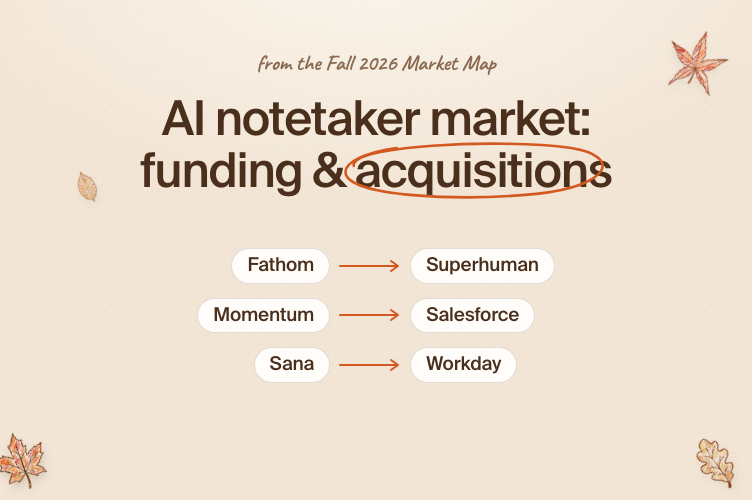
To see where these vendors sit across the market, and how the rest of the field is changing, read the full 2026 AI Meeting Assistant Market Map.