Lorem ipsum dolor sit amet, consectetur adipiscing elit, sed do eiusmod tempor incididunt ut labore et dolore magna aliqua. Ut enim ad minim veniam, quis nostrud exercitation ullamco laboris nisi ut aliquip ex ea commodo consequat. Duis aute irure dolor in reprehenderit in voluptate velit esse cillum dolore eu fugiat nulla pariatur.
MiFID II and FCA call recording: compliance for voice transcription in finance
TL;DR: Financial firms operating under MiFID II and FCA jurisdictions must maintain searchable, high-accuracy records of all client-related voice communications, including remote and mobile calls under FCA Market Watch 66. Engineering and product teams building for these obligations typically implement dedicated cloud infrastructure with defined data residency, controls that prevent customer audio from being used to retrain models on Growth and Enterprise plans, and transcription accurate enough that the resulting records hold up under regulatory review. Transcription and speaker attribution errors are not product quality issues in this context. They are audit trail failures, and regulators treat them as such.
Why speech-to-text accuracy matters upstream of your LLM
TL;DR: Downstream LLM performance is ceiling-bounded by upstream transcription accuracy. A transcript with a meaningful error rate doesn't produce proportionally degraded summaries or CRM entries. It produces outputs where hallucinated names, inverted logic, and misattributed speaker turns compound silently into every downstream system that reads them. Prompt engineering cannot recover information the STT layer never captured. Gravite cut call quality review time by 93%, from 15 minutes to 1 minute per call, once transcript accuracy was high enough to trust the output without manual verification.
TL;DR: Telephony audio is constrained to 8kHz narrowband frequencies, stripping away the high-frequency spectral energy that generic 16kHz STT models require. Standard upsampling cannot recover phonemes that were never captured at the source, leading to transcription errors that compound silently into downstream NLU failures. Solaria-3 ranks #1 on Switchboard, the most challenging conversational telephony dataset, ahead of AssemblyAI, ElevenLabs, Deepgram, Mistral, and Speechmatics, ensuring your downstream LLM pipelines receive clean, structured data from real-world noisy call audio.
Deepgram vs Gladia: Which speech-to-text API fits you the best (in 2026)?
Published on July 31, 2026
By Ani Ghazaryan
Choosing between Deepgram and Gladia for speech-to-text and audio intelligence comes down to to these five critical questions:
Do you need a comprehensive voice AI platform with text-to-speech and voice agents, or a pure-play speech AI infrastructure that won't compete with your product?
Is your priority proven scale and custom model training, or industry-leading real-time performance with optimized accuracy out of the box?
Are you building mainly for English (and now a handful of other languages), or do you need broad multilingual coverage with real-time code-switching?
Do you need on-premise or self-hosted deployment today, or is cloud-based processing with EU/US data residency enough?
Would you rather pay per-minute with add-ons billed separately, or per-hour with audio intelligence included?
Here's the TL;DR recommendation:
👉 Deepgram is an established, VC-backed voice AI platform for teams building complete voice-agent stacks. Its real-time-optimized Nova-3 model, the newer Flux conversational model built specifically for turn-taking, the Aura-2 text-to-speech line, and the Voice Agent API make it a one-stop shop for teams that want speech-to-text, text-to-speech, and orchestration from a single vendor. It's raised roughly $216 million to date, including a $130 million Series C in January 2026 at a $1.3 billion valuation and is said to have transcribed over a trillion words across more than 50,000 years of audio. That scale is real, but it comes with more moving parts: add-on pricing for features like diarization, and the fact that a "full voice AI platform" can end up competing with a voice-agent or CCaaS product you're trying to build on top of it.
👉 Gladia is the accuracy and multilingual-first speech AI infrastructure layer for teams that don't want to compromise on transcription quality or hand their audio data over for model training. It has two models: Solaria-1 for breadth and real-time streaming across 100+ languages and Solaria-3 for the highest accuracy on noisy, real-world English and European business audio. The choice depends on what "best" means for your use case. As a European (Paris-headquartered) company, Gladia leans into EU data residency with clusters across US as well and a stricter default on customer-data privacy. It bundles its audio intelligence features into every pricing tier, and positions itself as an infrastructure partner rather than a competitor to the products built on top of it.
Both platforms deliver solid real-time transcription. But they serve different priorities: Deepgram optimizes for platform breadth and price-per-minute at scale; Gladia optimizes for transcription accuracy, multilingual reach, and predictable, privacy-first pricing.
Table of contents:
Deepgram vs Gladia at a glance
The fundamental divide: platform breadth vs speech AI focus
Deepgram: a comprehensive voice AI infrastructure
Gladia: multilingual accuracy and developer experience
Real-time transcription performance compared
Audio intelligence features and bundling approaches
Real-time from $0.75/hr, async from $0.61/hr, all features included
Best for
Teams consolidating a full voice stack under one vendor
Teams building on top of speech AI who need multilingual accuracy and predictable costs
The fundamental divide: platform breadth vs speech AI focus
Deepgram started in 2015 when its founders, former particle physicists from the University of Michigan, applied deep learning to speech recognition instead of rule-based systems. A decade in, the company has grown well beyond transcription: it now offers text-to-speech through its Aura product line, a Voice Agent API that stitches together STT, an LLM, and TTS into one streaming session, and, more recently, a full speech-to-speech (STS) capability aimed at teams that want conversational voice AI without assembling the pipeline themselves.
Additionally, Deepgram has raised around $216 million across eight funding rounds, most recently a $130 million Series C in January 2026 that valued the company at $1.3 billion. That round also funded an acquisition (the YC-backed startup Ofone), an expanding patent portfolio around transformer-based ASR, and partnerships that now put Deepgram inside IBM's watsonx Orchestrate and on-device on Qualcomm Snapdragon hardware. The company says it has processed more than 50,000 years of audio and transcribed over a trillion words, serving 200,000+ developers and roughly 1,400 organizations — figures Deepgram itself publishes and updates periodically, so treat exact counts as directional rather than fixed.
Gladia took a different path when it was founded in 2022 by Jean-Louis Queguiner and Jonathan Soto. The company emerged from Queguiner's personal frustration with existing transcription services that couldn't accurately understand his French accent, highlighting the bias in models predominantly trained on English audio. This origin story shaped Gladia into a platform focused on speech recognition excellence, particularly for multilingual and international use cases.
The Gladia philosophy prioritizes getting transcription right without requiring significant technical investment, while remaining a partner rather than a competitor to customers. As a pure-play speech AI provider, Gladia deliberately stays focused on the input side of voice applications. Companies building voice agents typically need STT, LLMs, and TTS from different providers and, when an STT provider starts offering complete end-to-end solutions, it can create competitive tension.
So Gladia's focused approach means customers can integrate best-in-class speech recognition without worrying about vendor overlap with their own product roadmap.
This represents a fundamental market evolution: as some providers become voice AI generalists, Gladia has committed to being a speech AI specialist that optimizes exclusively for transcription and audio intelligence.
Deepgram excels at comprehensive voice agent AI infrastructure
Deepgram's current flagship transcription model is Nova-3, a general-purpose model for both pre-recorded and streaming transcription across 50+ languages. Sitting alongside it is Flux, a newer model built specifically for conversational voice agents rather than general transcription. Flux bakes in context-aware, model-integrated end-of-turn detection, deciding when a speaker has actually finished talking, not just paused, which Deepgram says cuts false interruptions by around 30% and shaves 200–600ms off agent response latency compared to a stitched-together STT-plus-VAD pipeline. Flux Multilingual, which reached general availability in April 2026, extends that same turn-detection behavior to 10 languages with live, mid-conversation language switching. Deepgram bills it as the first real-time conversational speech recognition model built for that use case.
The Voice Agent API remains Deepgram's push toward a single, unified conversational AI interface: one streaming connection that combines speech-to-text, LLM orchestration, and text-to-speech, with interruption handling built in. For teams building voice bots or assistants in-house, that reduces the work of gluing together separate vendors, though it also means Deepgram's roadmap and your product roadmap are more tightly coupled than they'd be with a transcription-only vendor.
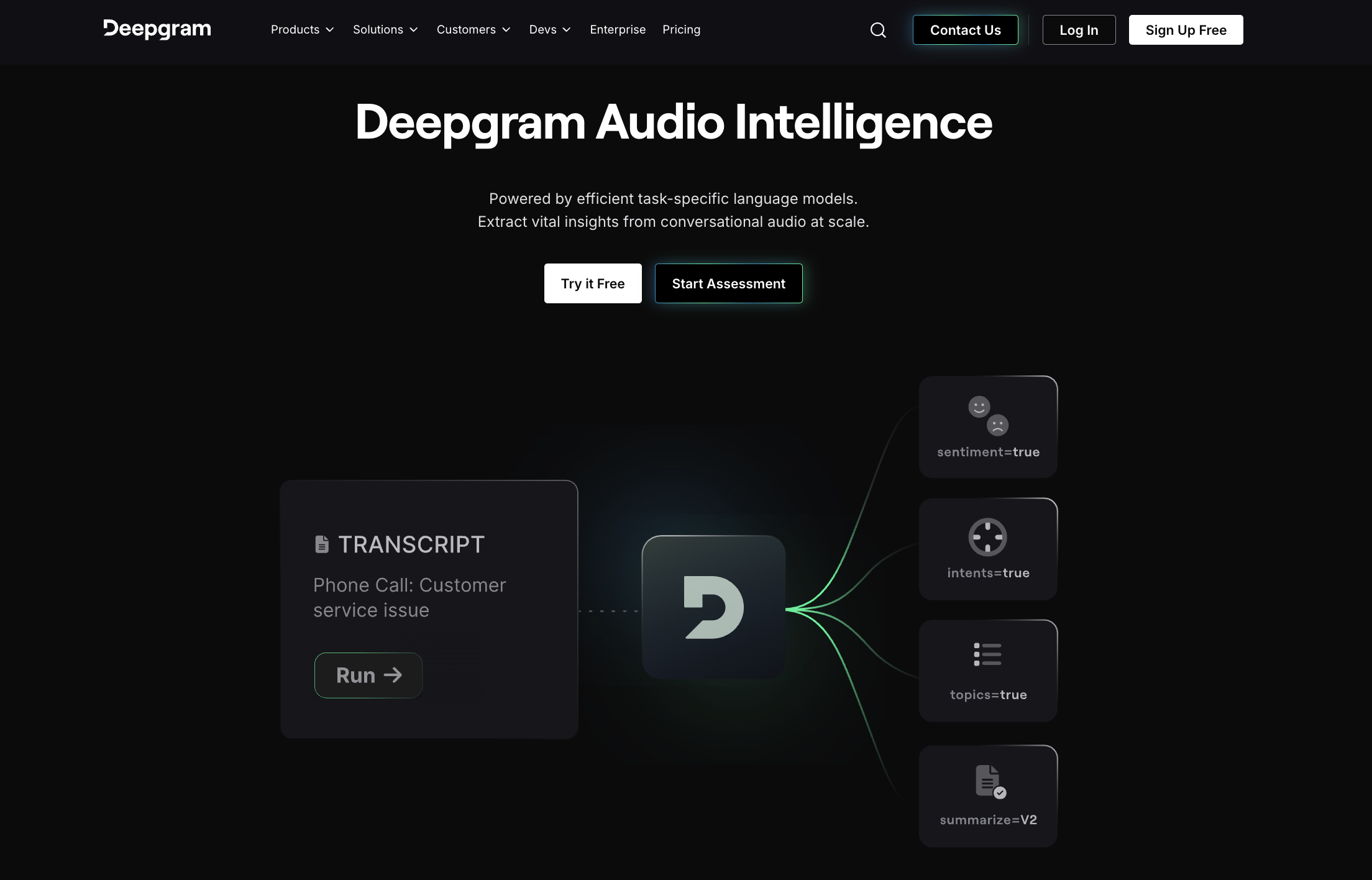
Audio intelligence features, including sentiment analysis, topic detection, summarization, and intent recognition, are add-ons on top of base transcription, powered by task-specific models. They're priced separately from transcription itself, per token rather than per minute, which can make budgeting less predictable for teams that want the full feature set.
The platform's flexibility extends to deployment options. Beyond cloud-based processing, Deepgram offers on-premise and dedicated deployments for organizations with strict data residency or security requirements. This is particularly valuable for regulated industries where data must remain within specific geographic or infrastructure boundaries.
Gladia dominates multilingual accuracy and developer experience
Gladia's current lineup has two flagship models that are meant to complement each other rather:
Solaria-1 is the breadth model — the most multilingual one in Gladia's lineup, with 100+ languages and native code-switching across all of them, including a large set of languages Gladia says aren't available through any competitor in this comparison. It's engineered to reduce hallucinated text on noisy, real-life audio, and it's built for both async and real-time workflows, with roughly 103ms partial latency and 270ms final latency. It's the model to reach for when language breadth, code-switching, or streaming performance matters most, including clean, formal, or institutional audio.
Solaria-3, released in June 2026, is purpose-built for noisy, real-world business audio: call-center recordings, sales calls, and anything conversational and imperfect. On Gladia's own benchmark, it ranks first across English and core European languages (EN, FR, DE, ES, IT), ahead of Deepgram, AssemblyAI, ElevenLabs, and Speechmatics, and it's about 26% more accurate than Solaria-1 on real English customer-call audio. It's currently async-only, so if you need real-time streaming or code-switching, Solaria-1 is still the right pick.
Multilingual support is where Gladia most clearly differentiates itself: 100+ languages with automatic language detection and native code-switching, useful for teams handling international business calls where speakers naturally move between languages mid-sentence. Given Gladia's European roots, multilingual handling has been a priority of the platform from the start.
The developer experience reflects an API-first approach: clear documentation, SDKs for Python and TypeScript, telephony-protocol support (SIP, VoIP), and integrations with partners like Pipecat and LiveKit for building real-time and async voice applications quickly. A no-code playground lets developers test the API before writing anything.
"Their transcription quality is the best for many languages. Their support is high quality; you can even contact their CTO, etc. Their documentation is clear and easy to integrate, and implement." - Verified user review of Gladia
Async and real-time transcription performance compared
The two vendors optimize for different things, and that shows up differently depending on whether you're looking at batch (async) accuracy or real-time streaming latency.
Accuracy on async: Gladia’s Solaria-3 is #1 on real-world audio
Gladia's own Solaria-3 currently sits at #2 on the Hugging Face Open ASR Leaderboard private-data track. That placement carries a lot of weight since the leaderboard itself and the private-track audio aren't controlled by Gladia or any other vendor. Though it's still worth checking the live leaderboard yourself, since rankings shift as new models are submitted.
Gladia also publishes its own benchmark, along with an open-source and reproducible methodology. On that benchmark, Solaria-1 ranks #2 on Switchboard, widely considered one of the hardest conversational-audio tests, at 37.3% WER, behind only Solaria-3, which takes the #1 spot outright on the same test. Solaria-1 also leads separately on speaker diarization accuracy, with a diarization error rate (DER) roughly 3x more accurate than the alternatives in the market. That’s a meaningful edge for any workload where knowing who said what matters as much as what was said.
"Excellent multilingual real-time transcription with smooth language switching... Superior accuracy on accented speech compared to competitors... Clean API, easy to integrate and deploy to production." - Yassine R. on G2
In its Solaria-3 launch benchmark, the model scores 6.4% WER on Earnings22 Cleaned AA — a financial- and business-call dataset that's part of the long-form English test sets used by the Open ASR Leaderboard. The same benchmark places Deepgram at 12.0% WER on that set, the widest gap of any provider Gladia compares against. The benchmark is built on a public dataset with published methodology, which makes it more verifiable than a bare marketing claim: you can pull the Earnings22 set and the open code and re-run it yourself.
Deepgram publishes its own accuracy figure for Nova-3, commonly cited around 5.26% WER, but that's measured against an internal, Deepgram-controlled test set, so it isn't directly comparable to the numbers above. Gladia's benchmark page does include Deepgram directly, tested on the same audio files as Solaria: on Switchboard, Deepgram Nova-3 scores 49.8% WER, versus 37.3% for Solaria-1 and 33.9% for Solaria-3 — trailing both models and landing near the bottom of the field. It trails both Solaria models again on Earnings22 Cleaned AA, where it comes in last of the seven providers Gladia tested. On Gladia's real-customer-audio set it lands closer to the middle of the pack, ahead of Solaria-1 but still behind Solaria-3. It's not a clean sweep either way, though: Deepgram edges out Solaria-3 on the multilingual LibriSpeech average, even as it continues to trail Solaria-1 there, and its real-time factor is consistently decent in Gladia's results, which matters if throughput on batch jobs is your bottleneck rather than raw WER. Validate against your own audio before making a production decision.
On real-time performance: solid streaming across both platforms
Both platforms deliver solid streaming transcription, with different architectural priorities.
Deepgram offers sub-300ms streaming latency through a WebSocket API, built to handle high volumes of concurrent connections. Streaming supports interim results (fast, unconfirmed feedback) and live speaker diarization. For voice-agent use cases specifically, the Voice Agent API and Flux together handle the added complexity of coordinating STT, LLM processing, and TTS output, including turn-taking and interruptions, without you having to build that orchestration yourself.
Gladia was built real-time-first from the start. Solaria-1's partial latency comes in at ~103ms. That's about twice as fast as competitors on this specific metric, which matters most for voice agents where a fast initial acknowledgment shapes how natural the conversation feels. Final transcript latency lands around 270ms. Gladia's real-time API supports the same audio intelligence features available in batch processing, including sentiment analysis and named entity recognition, streamed back over the same WebSocket connection, with code-switching working live as speakers change languages mid-conversation.
"Gladia provides a highly accurate real-time speech-to-text solution for high volumes of support and service calls. Latency is low and accuracy high, even for numericals." - Verified User in Financial Services on G2
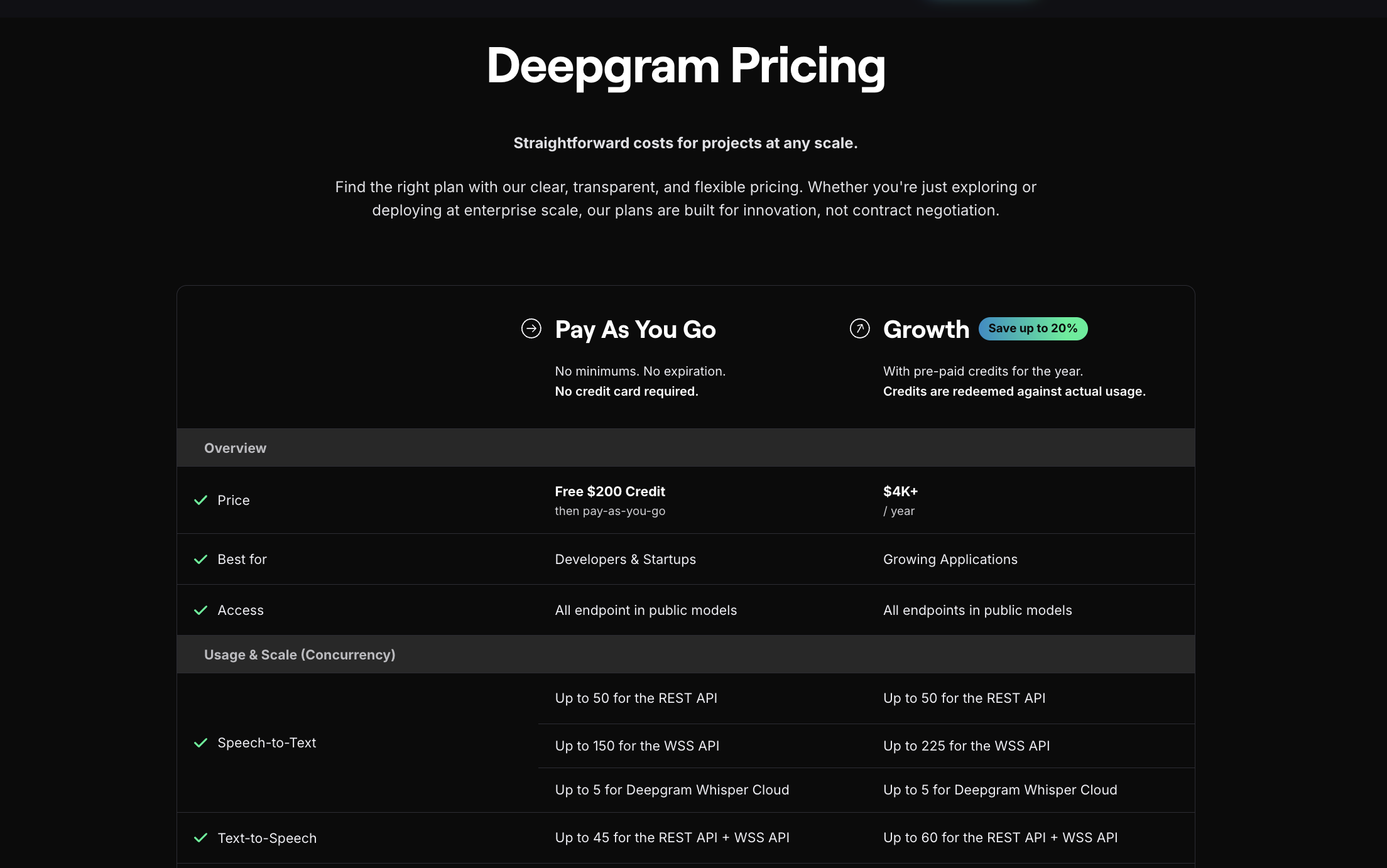
Both platforms scale concurrent-connection limits with pricing tier. Deepgram's Pay-As-You-Go plan supports up to 150 WebSocket connections; Gladia's Starter plan supports 30 concurrent real-time requests, with higher limits on paid tiers. Gladia also offers both US and US clusters alongside its default European infrastructure.
Audio intelligence features and bundling approaches
Deepgram treats audio intelligence as modular add-ons layered on top of base transcription. On current published Pay-As-You-Go rates, speaker diarization and PII redaction each add about $0.0020/minute, and keyterm prompting adds about $0.0013/minute. Each roughly 20–26% on top of the base Nova-3 rate. A separate set of capabilities (sentiment analysis, summarization, topic detection, and intent recognition) runs on task-specific language models and is billed per token rather than per minute, which makes a clean per-hour cost comparison difficult. Translation and entity detection aren't currently available as Deepgram STT add-ons at all.
This modular approach is genuinely useful for teams that only need bare transcription and want to avoid paying for capabilities they won't use. But for teams that want the full feature set, the add-on costs stack: a fully-loaded Nova-3 pipeline with diarization, redaction, and keyterm prompting can run meaningfully above the advertised base rate, commonly cited as roughly a 60–70% premium over the sticker price once every add-on is enabled.
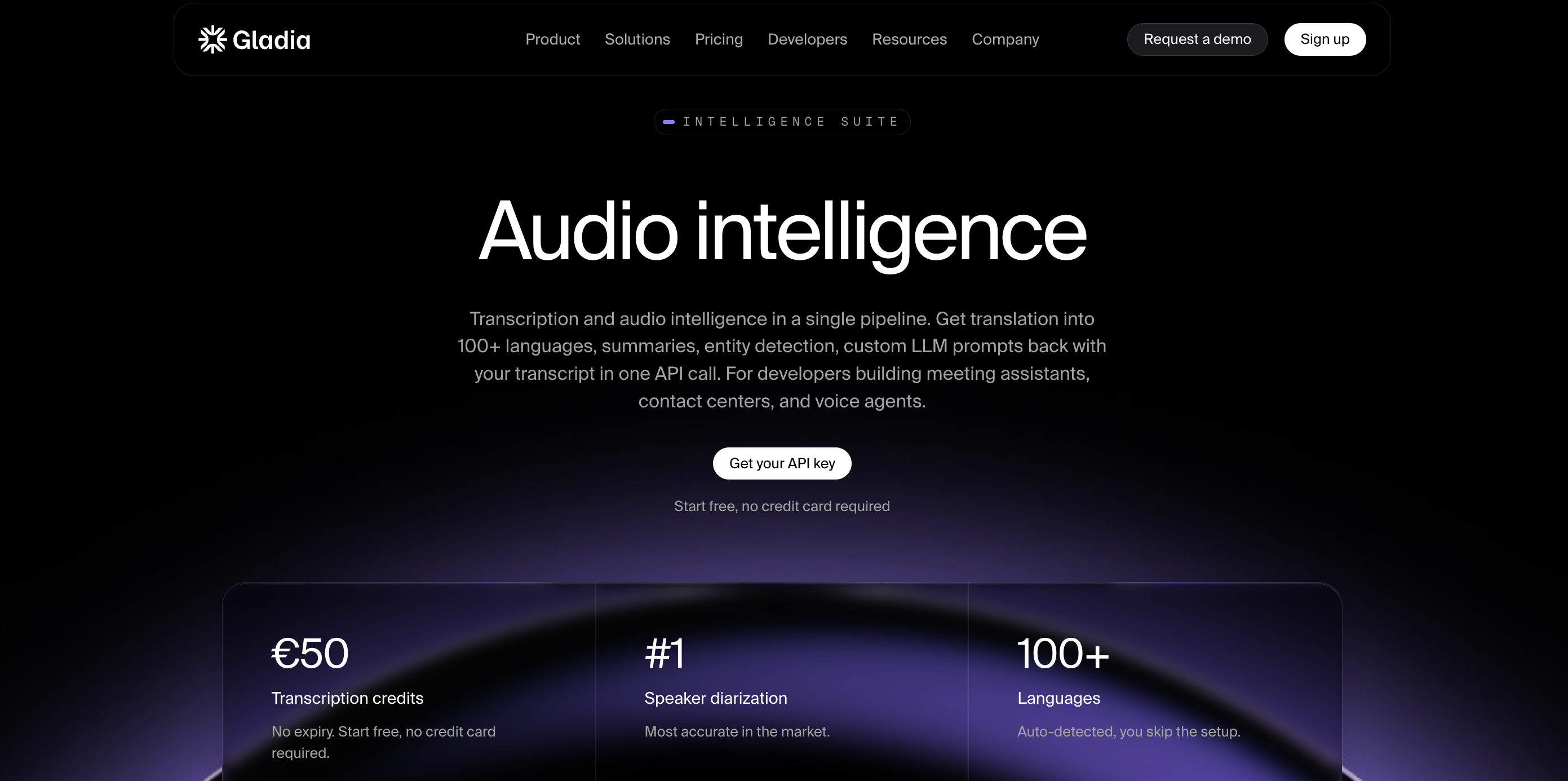
Gladia includes audio intelligence in the base price at every tier. Speaker diarization, word-level timestamps, sentiment analysis, summarization, and named entity recognition ship without separate per-feature charges. Summarization offers three modes (general overview, concise snapshot, and bullet-point takeaways); sentiment analysis works at the sentence level and, combined with diarization, can attribute sentiment to individual speakers; named entity recognition pulls out people, organizations, locations, dates, and email addresses automatically.
Both platforms support custom vocabulary. Deepgram's route for enterprise customers is custom model training; Gladia offers dynamic custom vocabulary with per-user, per-language, and per-term weighting, aiming for high precision on domain-specific terms without full model retraining.
Pricing models reveal different philosophies
Deepgram prices per minute, with rates varying by model and add-ons. On Pay-As-You-Go, Nova-3 Multilingual streaming runs about $0.0092/minute (roughly $0.55/hour); the Growth tier, which requires a $4,000+ annual prepay commitment, brings that down to about $0.0078/minute. Monolingual Nova-3 streaming is cheaper: around $0.0048–0.0077/minute depending on the source and whether it's batch or streaming. So using the multilingual model only when you actually need it matters for cost control. New Pay-As-You-Go accounts get a one-time $200 credit with no expiration.
Flux and Flux Multilingual are priced separately from Nova-3 and generally sit somewhat higher per minute given the added turn-detection processing; the Voice Agent API is billed on its own schedule as well, and Aura-2 text-to-speech runs about $0.03 per 1,000 characters. Add-ons (diarization, redaction, and keyterm prompting) layer on top of the base transcription rate, and Audio Intelligence features (sentiment, summarization, topic detection, intent recognition) use a separate per-token billing model entirely.
One detail worth flagging clearly: Deepgram's published rates assume enrollment in its Model Improvement Partnership Program, which uses customer audio to help train future models. Opting out is possible, but it means forgoing a discount reported at up to 50%. Effectively, you pay more to keep your audio out of training data.
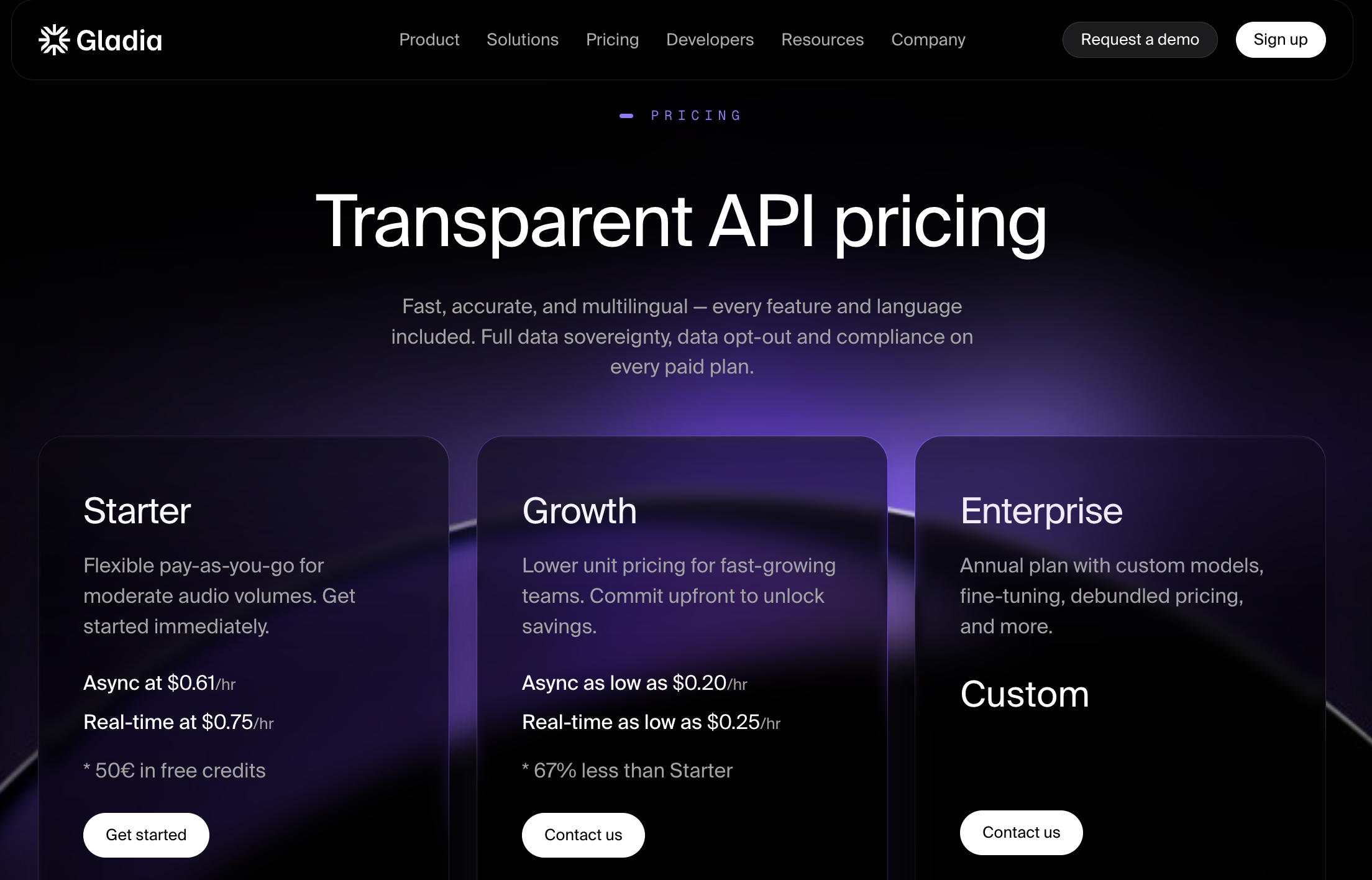
Gladia prices per hour with a simpler, largely all-inclusive structure. The Starter tier runs $0.75/hour for real-time and $0.61/hour for async transcription, with every new account receiving €50 worth of free credits, with no expiry – enough to test the async and real-time capabilities across Solaria models. The Growth tier brings real-time down to roughly $0.25/hour and async to $0.20/hour, which is as much as 67% below the Starter rate, with all languages and all audio intelligence features included at every tier, no per-feature math required. Enterprise pricing is custom and adds unlimited concurrency, custom hosting, and zero data retention. Note that customer data is never used to train models across Growth and Enterprise tiers, no opt-out required, while the Starter plan may use your audio for model training purposes.
To compare like-for-like, it helps to price out an equivalent feature set, multilingual model and diarization included, rather than comparing sticker prices alone:
Gladia Starter (diarization and all audio intelligence features included): $0.75/hour
Gladia Growth (same features included): $0.25–0.55/hour depending on volume commitment
That comparison still understates the gap once you add Deepgram's other per-minute add-ons (redaction, keyterm prompting) and its separately-billed, per-token Audio Intelligence suite, none of which Gladia charges for separately. Gladia also doesn't require customers to opt into a training-data program to get its listed rates, unlike Deepgram's Model Improvement Program discount structure.
Security, compliance, and data privacy
Both platforms maintain enterprise-grade security, but differ meaningfully on how they treat customer data by default.
On data usage for training, Deepgram's Model Improvement Partnership Program uses customer audio to improve its models by default; customers can opt out via an API parameter, but doing so forgoes the associated pricing discount. For organizations that need full control, Deepgram's on-premise deployment option (including a license proxy for high-availability self-hosted setups) sidesteps the question entirely by keeping data off Deepgram's infrastructure altogether.
Gladia holds SOC 2 certification and is HIPAA-compliant, with GDPR, ISO27001, and HDS compliance by design and primary processing on European infrastructure along with US clusters. All data is encrypted in transit and at rest. The clearer differentiator is Gladia's default stance on training data: for paid plans, customer audio is never used to retrain models, with no discount forfeited and no separate opt-out required. Only free-tier usage may be used for training.
Data retention on Gladia is configurable, with options down to zero-day retention for enterprise customers. On-premise and air-gapped deployment are on Gladia's roadmap for enterprise customers but aren't generally available yet.
Deepgram vs Gladia: which should you choose?
The choice between Deepgram and Gladia depends on your specific requirements, technical capabilities, and strategic priorities.
Choose Deepgram if:
You want a full voice AI stack, with transcription, text-to-speech, and voice-agent orchestration included from a single vendor
Custom model training on your own vocabulary or domain is important
You need on-premise or VPC deployment today, not on a future roadmap
You're building conversational voice agents and want Flux's native turn-taking and interruption handling
Your team can manage modular, add-on-based pricing without it becoming unpredictable
You're comfortable with your audio being used to improve Deepgram's models (or are willing to pay more to opt out)
You value proven scale, a well-funded platform used by large enterprise customers
Choose Gladia if:
Your priority is transcription accuracy and low partial latency, especially on noisy or accented audio
Code-switching between languages is common in your audio
You want audio intelligence features bundled in rather than metered separately
Data privacy is non-negotiable and you don't want to trade discounts for keeping your audio out of training sets
EU/US data residency and strong compliance matters to your organization
You want predictable, per-hour pricing rather than stacked per-minute add-ons
The speech-to-text API market in 2026 offers strong options for different needs.
Deepgram has built a comprehensive voice AI infrastructure that serves as a one-stop platform for organizations wanting to consolidate their voice technology stack. Its custom model training, text-to-speech capabilities, and unified Voice Agent API provide flexibility for complex enterprise deployments where vendor consolidation is a priority.
Gladia has established itself as a pure-play speech AI alternative that prioritizes transcription excellence, developer experience, and transparent practices. Designed as an async-first platform, along with decent real-time support, its included features, strong multilingual capabilities, and commitment to never training on customer data (for paid plans) make it particularly attractive for teams building on top of speech AI who want a vendor that will remain a partner, not a competitor.
Your decision should align with both your immediate transcription needs and your longer-term product strategy.
Organizations planning to build comprehensive voice applications in-house may find Deepgram's platform breadth valuable. Those focused on getting accurate, real-time transcripts into their applications quickly, especially in international or privacy-conscious contexts, will appreciate Gladia's focused and transparent approach.
See if for yourself
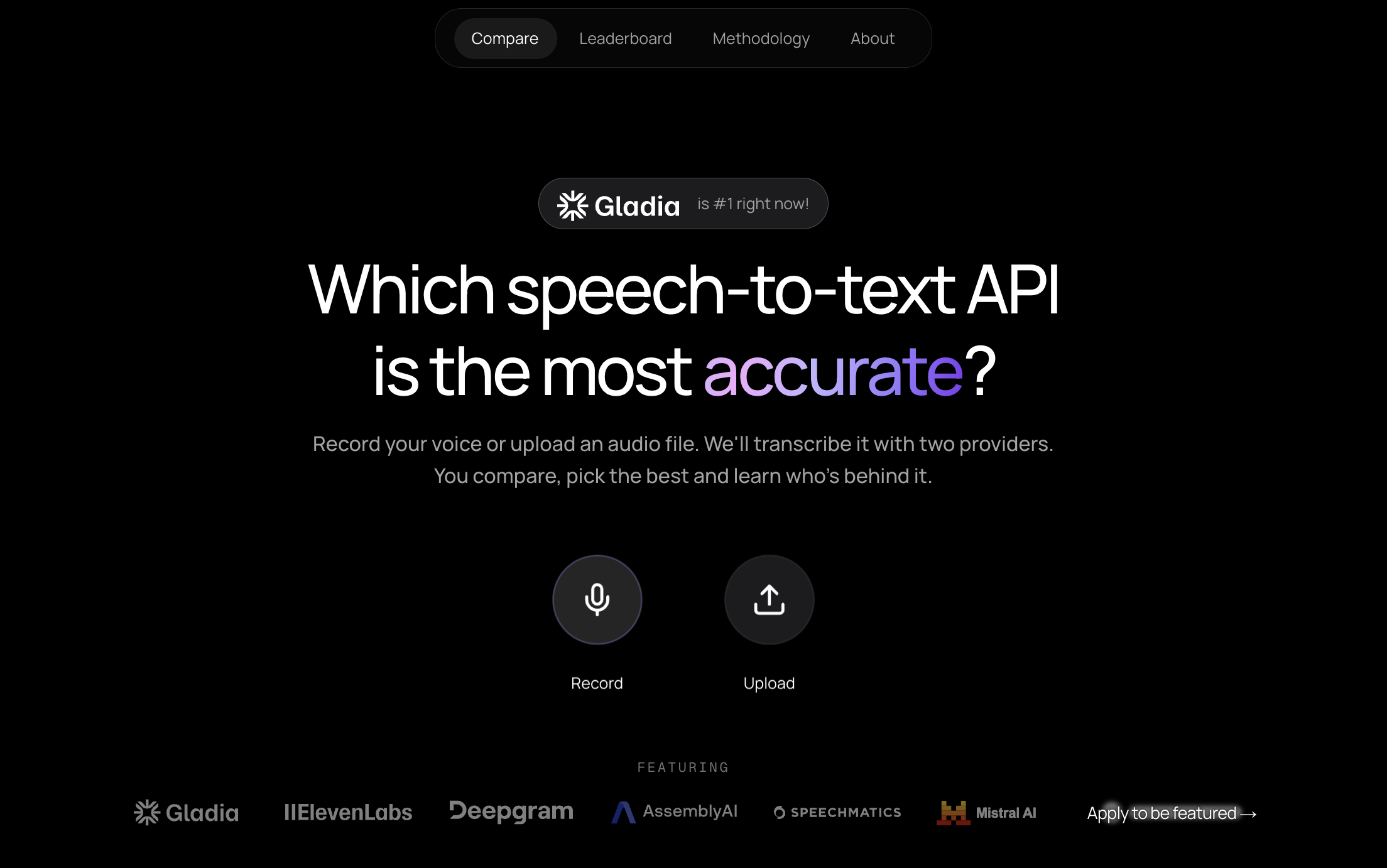
For a quick, lighter-weight gut-check, Gladia also runs Compare STT, a blind comparison tool covering Gladia, Deepgram, AssemblyAI, ElevenLabs, Speechmatics, and Mistral. You upload or record up to two minutes of audio, the tool transcribes it with two randomly selected providers, and you pick which transcript reads better without knowing who made which one until after you've voted. The results feed a live, community-driven leaderboard.
It's a fun experiment, and worth a couple of minutes if you want a quick blind read on relative quality. But it isn't a rigorous evaluation, and shouldn't be treated as one. If you're making an actual vendor decision, reproduce a proper benchmark on your own representative audio, side by side, before you commit.
Get started with €50 worth of free credits, no expiry, so you can test Solaria-1 or Solaria-3 against your own audio at real volume before committing to a plan. Sign up and start transcribing.
FAQs
Is Deepgram or Gladia more accurate?
On Gladia's own open-source and reproducible benchmark, which tests both vendors on identical audio, Solaria-3 ranks first among seven providers on English and core European languages (EN, FR, DE, ES, IT) and beats Deepgram Nova-3 on Switchboard (33.9% vs. 49.8% WER) and Earnings22. Deepgram does edge out Solaria-3 on the multilingual LibriSpeech average. Because these numbers come from Gladia's testing, validate against your own representative audio before deciding.
Which one is cheaper, Deepgram or Gladia?
For a comparable feature set (multilingual model plus diarization), Deepgram's Pay-As-You-Go rate runs about $0.67/hour and Gladia's Starter tier is $0.75/hour, with Gladia Growth dropping to $0.25–0.55/hour depending on volume. The gap widens once Deepgram's other add-ons (redaction, keyterm prompting, per-token Audio Intelligence) are factored in, since Gladia bundles all audio intelligence features into every tier at no extra cost.
Does Gladia offer text-to-speech or voice agents like Deepgram?
No. Gladia is a pure-play speech-to-text and audio intelligence provider with no TTS or Voice Agent API. Deepgram offers both: Aura-2 for text-to-speech and a Voice Agent API that unifies STT, LLM orchestration, and TTS in one streaming connection.
Which has lower real-time latency, Deepgram or Gladia?
Both are fast. Deepgram delivers sub-300ms streaming latency via WebSocket, with Flux adding context-aware turn detection for voice agents. Gladia's Solaria-1 posts ~103ms partial latency and 270ms final latency, about twice as fast as competitors on the partial-latency metric.
Does Deepgram or Gladia train on my audio data?
Deepgram's Model Improvement Partnership Program uses customer audio to train future models by default; opting out means forgoing a discount of up to 50%. Gladia never uses paid-tier (Growth and Enterprise) customer audio for training, with no opt-out required and no discount forfeited, only its free/Starter tier may use audio for training.
Which supports more languages, Deepgram or Gladia?
Gladia supports more languages with deeper code-switching: Solaria-1 covers 100+ languages with native code-switching, including languages not available through Deepgram. Deepgram's Nova-3 covers 50+ languages, and Flux Multilingual adds live mid-call switching across 10 languages.
Does Deepgram or Gladia offer on-premise deployment?
Deepgram offers on-premise, VPC, and cloud deployment today. Gladia currently offers cloud deployment with EU and US data-center clusters; on-premise and air-gapped deployment are on its enterprise roadmap but not yet generally available.
Should I choose Deepgram or Gladia?
Choose Deepgram if you want a consolidated voice AI stack (STT, TTS, voice agents) from one vendor, need custom model training or on-premise deployment now, and can manage add-on-based pricing. Choose Gladia if transcription accuracy, multilingual code-switching, bundled audio intelligence pricing, and default data-privacy protections matter more than platform breadth.
Contact us
Your request has been registered
A problem occurred while submitting the form.
Read more
Speech-To-Text
MiFID II and FCA call recording: compliance for voice transcription in finance
Speech-To-Text
Why speech-to-text accuracy matters upstream of your LLM